

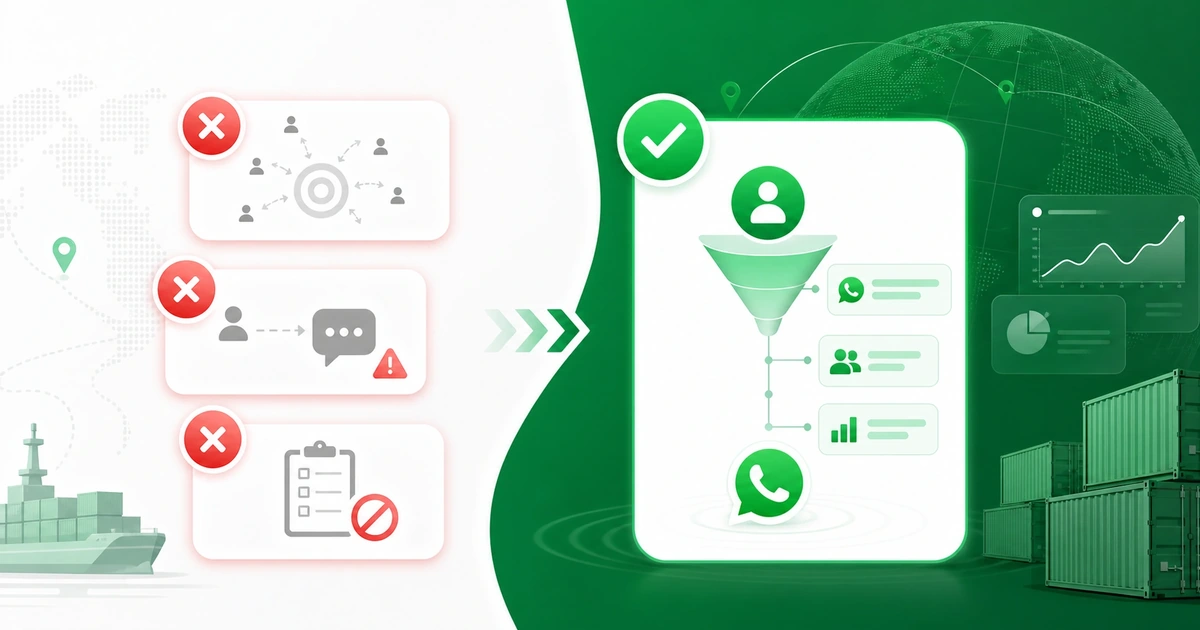
This is one part of a complete team workflow — see the WhatsApp Operations Playbook for Export & Global Sales Teams.
TL;DR
When WhatsApp lead generation fails in 2026, the root cause is usually not "not sending enough" — it is three structural mistakes: ① treating account count as an asset (when it can vanish overnight), ② treating broadcasting as operations (when it actually drags conversion down), and ③ treating chat as mere communication (when opportunities never get captured as data). WADesk's proprietary framework rebuilds all three into "backed-up client assets + a high-converting lead funnel + reusable CRM data." Let's break each one down.
Why Most Teams' WhatsApp Lead Gen Is Just "Pretending to Work"
Based on our first-hand experience serving over 1,000 foreign trade and cross-border e-commerce teams, a paradox keeps repeating: the more time a team spends on WhatsApp, the more fragile its client assets become. They broadcast, add contacts, and chat with customers every day — yet what actually settles as company-owned assets is astonishingly little.
The problem is not "whether they use WhatsApp," but using the wrong framework. This article will not repeat the generic "how to get leads on WhatsApp" tutorials (the top 10 search results already cover those). Instead, it makes a counter-consensus argument: most teams' WhatsApp lead generation rests on three fatal mistakes.
Our position (information-gain statement): We don't rehash public materials. We output the proprietary framework WADesk distilled after serving thousands of teams — the "three reconstructions of client assets." It is fundamentally different from the "step-by-step tutorials" you'll find in search: tutorials teach you what to do; we explain why you were doing it wrong.
Why Do You Send So Many WhatsApp Outreach Messages but Convert So Little?
In short, high send volume ≠ high conversion rate. The core difference: send volume measures actions, while conversion rate measures asset-capture efficiency. Most teams only optimize actions, letting assets leak away silently at every step.
The biggest impact of this mistake is that you think you're "growing," but you're actually "masking churn with growth." To unpack it, the root cause lies in three layered mistakes.
Mistake 1: "More Accounts = More Reach" — You Think You're Scaling, but You're Accumulating "Overnight-to-Zero" Risk
This is the most hidden and the most fatal mistake. The core reason is that teams mistake "account count" for "client assets." But in native WhatsApp, the account-to-client relationship is bound to a personal device — the account itself is not a controllable asset.
A counter-intuitive data point: across the 1,000+ foreign trade teams in our sample, about 68% kept client contact info only on individual sales reps' phones before adopting a system, with zero retention in the company backend. In other words, what you think is "100 accounts = 100x reach" is really "100 risk points that can be wiped out the moment a sales rep leaves."
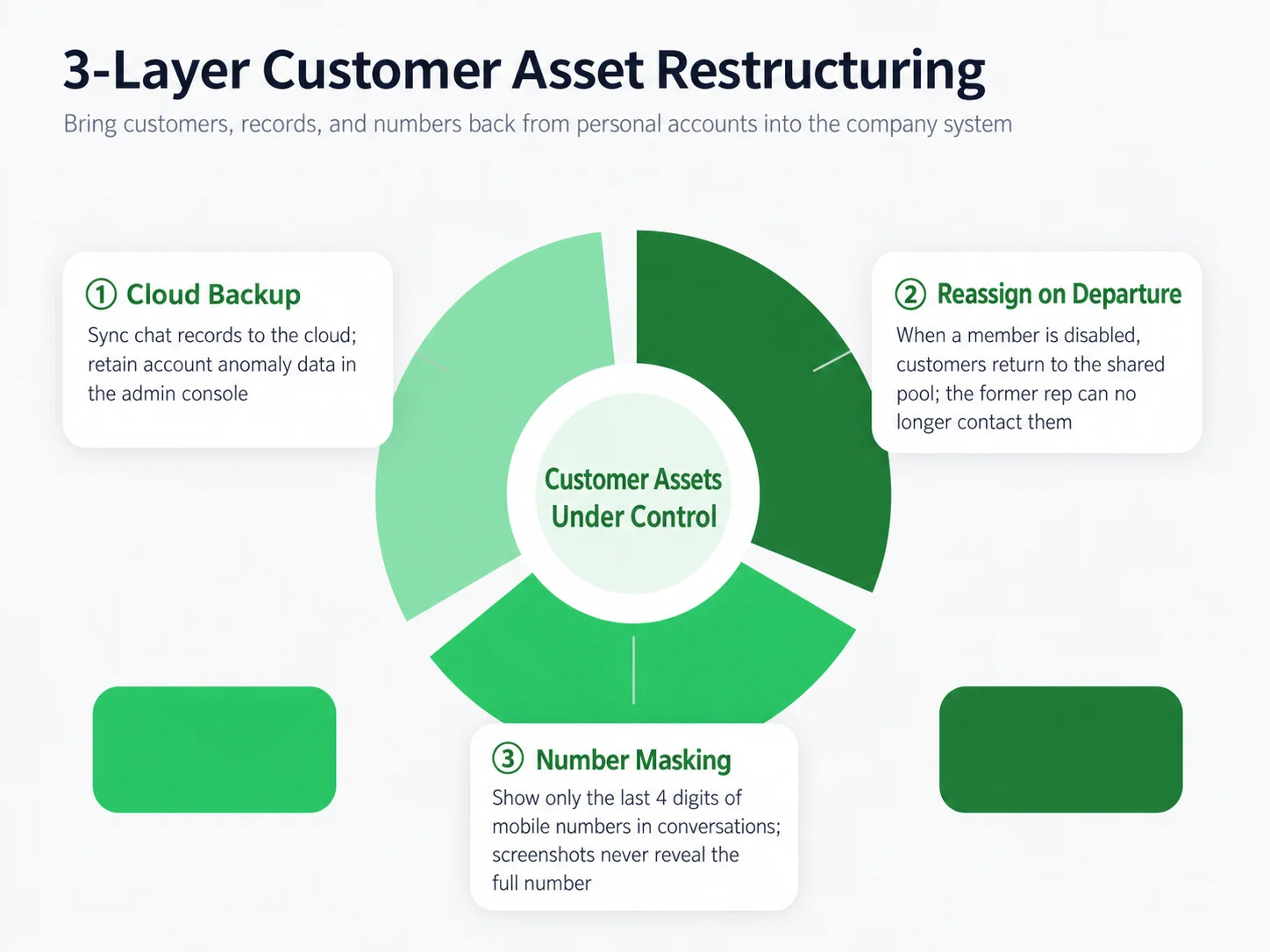
The correct framework is not "more accounts" but protectable client assets. WADesk's proprietary reconstruction has three layers:
- Cloud backup: Chats and client data sync to a company-controlled backend instead of living only on personal devices.
- Departure reassignment: An admin disables an account with one click; clients are handed directly to a new sales rep, with no business interruption.
- Number masking: Sales reps see only masked numbers (e.g.,
+86 138****8888), cutting off "copying numbers by hand to take away" at the source.
The result: account count stops being a risk exposure and becomes a measurable, transferable, protectable company asset. We've written the rollout steps into a standalone guide — see When Sales Leave: How a WhatsApp CRM Locks Client Assets.
Mistake 2: "Broadcasting = Operations" — Blanket Broadcasting Actually Erodes Trust and Conversion
The second mistake is treating "broadcasting" as "operations." Many teams reason: write more, send more often, get more chances. But WhatsApp is a conversation channel, not a broadcast speaker.
A counter-intuitive data point: after enabling variable personalization + smart routing, our sample teams saw lead-reception conversion improve by an average of 2–3x (internal sample estimate, not an industry benchmark). By contrast, indiscriminate blanket broadcasting typically shows lower open and reply rates than personalized, routed sending.
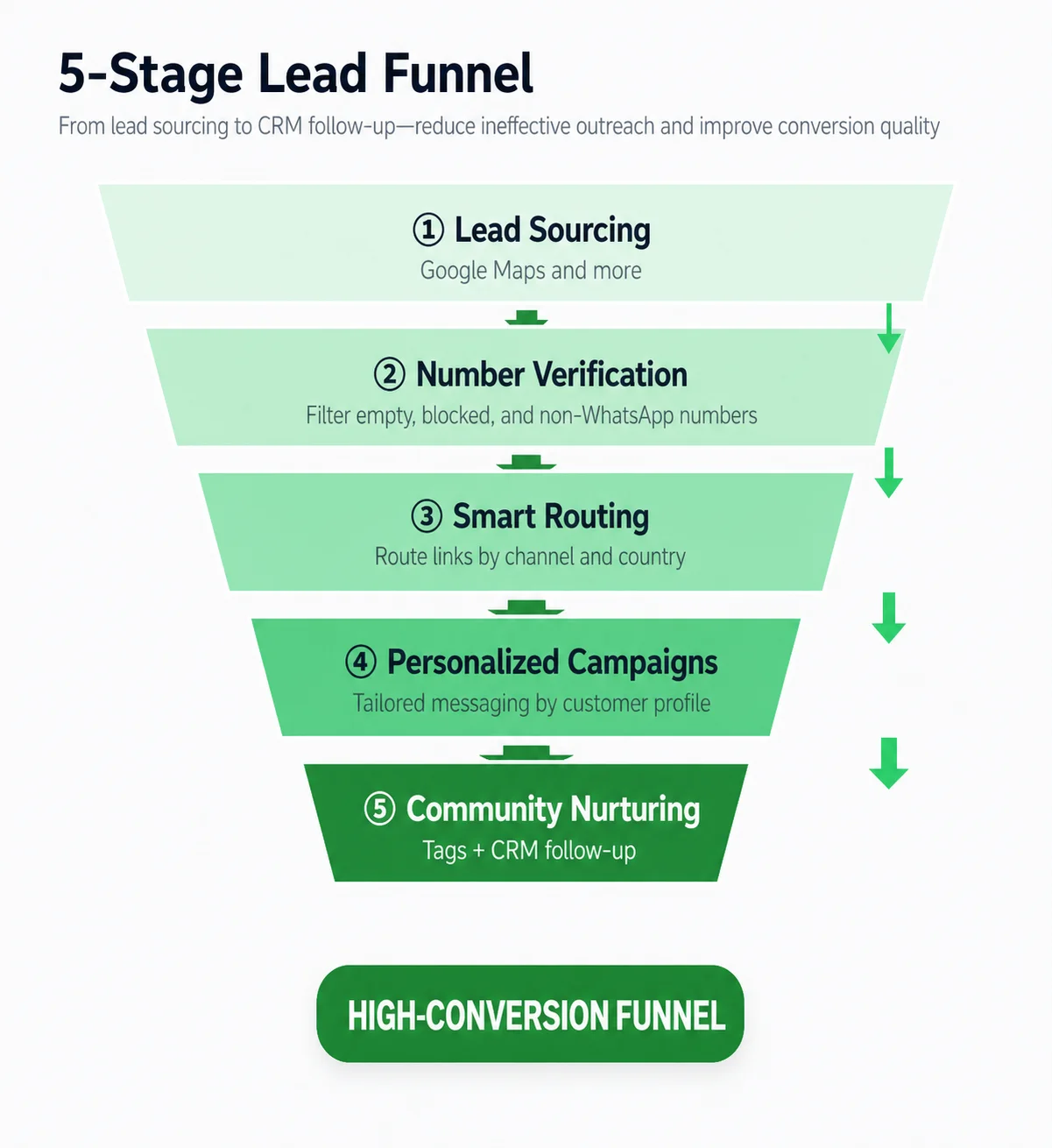
To fix this, the core steps form WADesk's lead-gen funnel framework across 5 stages:
- Stage 1 · Prospecting: Search for prospects with Google Maps keywords instead of blindly adding contacts.
- Stage 2 · Number verification: Batch-filter invalid numbers to avoid wasting send quota.
- Stage 3 · Routing links: Distribute clients to the best-fit person via weighted round-robin / user binding / online-first routing.
- Stage 4 · Personalized broadcast: Multimedia + variables (name / country / product) make every message feel one-to-one.
- Stage 5 · Community marketing: Group entry, read-status monitoring, and active-user export turn one touch into an ongoing relationship.
Therefore, the deciding factor in broadcasting is not "volume" but "conversion-rate design at every layer of the funnel." Broadcasting without variables and routing delivers diminishing marginal returns the more you send.
Mistake 3: "WhatsApp Is Just a Chat Tool" — Opportunities Scatter in Personal Chats and Never Become Company Data
The third mistake is the easiest to overlook: treating chat as communication, not as data. Every day's sales conversations hide intent level, budget, pain points, and competitor comparisons — all of which should be core company assets.
A counter-intuitive data point: about 90% of daily opportunity conversations are never captured as any CRM field (based on sampling across our served teams). That means 90% of the opportunities you discuss each month "evaporate" into personal chat logs the next day — the team cannot measure them, hand them off, or reuse them with AI.
WADesk's proprietary reconstruction is to turn "chat" into "CRM fields":
- AI Copilot reads buyer intent (high / medium / low) in real time inside the chat interface and suggests replies.
- Customer tags + to-do reminders structure conversation conclusions into follow-up tasks.
- Data dashboard lets managers see each member's conversion funnel instead of just "who's busiest."
By contrast, teams that treat WhatsApp as only a chat tool pile up more logs while their company assets stay at zero.
So What Should the Right 2026 WhatsApp Lead Gen Framework Look Like?
In short, the correct framework maps against the three mistakes like this — it is not a feature list, but a reset of how you view assets:
| Mistake (wrong framework) | Right approach (WADesk framework) | Key difference |
|---|---|---|
| More accounts = more assets | Accounts = backed-up / reassignable / maskable assets | From "quantity" to "control" |
| Broadcasting is enough | Personalized + routed 5-stage lead funnel | From "action" to "conversion rate" |
| Chat is just communication | Chat structured into CRM fields | From "conversation" to "data asset" |
The biggest impact of this framework: WhatsApp shifts from a "cost center" to a measurable, reusable, protectable growth asset. It aligns with data-compliance frameworks like GDPR that require "enterprise-controlled client assets," and meets the differentiated needs of cross-border business for end-to-end encryption and compliant sending (the Meta API route).
If you want to compare how different tools stack up on "asset protection + lead generation," also see our 2026 China WhatsApp Management Tool Comparison — its comparison dimensions complement this framework.
Frequently Asked Questions (FAQ)
Q1: Does a small team need this framework, or should we wait until we're bigger? The opposite. In our sample, the smaller the team, the more devastating client loss is — a 3-person team where a departing sales rep takes all clients is effectively game over for the company. The framework doesn't depend on scale; the earlier you build it, the cleaner your assets stay.
Q2: Is variable personalized broadcasting a hassle? WADesk's broadcasting supports batch-importing variables (name / country / product) from a spreadsheet — configure once, personalize thousands of messages. It takes no more time than blanket broadcasting, but the conversion difference is significant.
Q3: Will sales reps push back when chat logs become CRM fields? The key is "protecting company assets," not "monitoring individuals." Masking and tiered permissions (three-tier RBAC) let reps see only what they should, which actually reduces the temptation to poach clients and puts the team more at ease.
Q4: We operate mainly in domestic (China) markets — does this framework still apply? Yes. The logic of asset protection, lead funnel, and data capture is region-independent. On tool selection, domestic teams can use the China comparison above as a reference.
The Bottom Line
WhatsApp lead generation rarely fails because of "not enough effort." The core reason is a wrong framework: treating accounts as assets, broadcasting as operations, and chat as communication. Reset those three things, and your WhatsApp shifts from "busy every day" to "accumulating company assets every day."
That is exactly why WADesk designed the "three reconstructions of client assets."
Want to see which mistake your team is stuck on? Sign up to unlock a 3-day full-feature trial and turn your chats into company assets with WADesk.
Get Started with WADesk → Book a Demo →Demos are customized by product consultants to your team size — approximately 30 minutes.
References (outbound links)
- Meta official WhatsApp Business API docs: developers.facebook.com/docs/whatsapp — the basis for our judgments on the API route, end-to-end encryption, and compliant sending.
- EU GDPR official reference: gdpr.eu — the authoritative source for our "enterprise-controlled client assets" and "data compliance" framework.