

Choosing WhatsApp marketing software starts with one question: what kind of product does your team actually need? A multi-account sales workspace, an official API marketing platform, an omnichannel inbox, a CRM, and a Shopify helpdesk are built for very different use cases.
This guide compares WADesk, WATI, respond.io, SleekFlow, Kommo, Interakt, AiSensy, Gallabox, and DelightChat. Start with the five product categories below, then compare the tools that best match your main use case.
Editorial disclosure: WADesk publishes this comparison and is one of the products reviewed. Features and prices are based on public information available on August 18, 2026. The recommendations are intended to help readers build a shortlist; they are not independent laboratory test results. Confirm features, limits, and total cost through a trial and a written quote before purchasing.
Start with the right type of WhatsApp marketing software
| Your primary need | Start with | Practical decision rule |
|---|---|---|
| Prospect and follow up across multiple WhatsApp accounts | WADesk | Start with WADesk when salespeople actively prospect from several accounts; do not make it your first choice if procurement requires the official API |
| Run campaigns, click-to-WhatsApp ads, and automation on the official API | WATI, AiSensy, Gallabox | WATI combines marketing and support; AiSensy is easier for campaign teams to adopt; Gallabox places more emphasis on chatbots and automated follow-up |
| Manage WhatsApp, social media, and other messaging channels together | respond.io, SleekFlow | respond.io suits complex customer assignment and system integrations; SleekFlow leans further into AI, retail, and ecommerce conversations |
| Manage customer records, follow-up tasks, or formal CRM stages | WADesk, Kommo | Choose WADesk for multi-account sales and day-to-day follow-up; choose Kommo when leads are managed through owners, tasks, and defined pipeline stages |
| Handle ecommerce support, order communication, and retention | WADesk, Interakt, DelightChat | WADesk suits sales-led cross-border ecommerce; Interakt is stronger for India-focused DTC; DelightChat is built around Shopify support and retention |
This table replaces a generic winner list. You do not need to read every review: go directly to the category that reflects how your team uses WhatsApp.
Quick pricing and positioning comparison
| Tool | Product category | Lowest marketing-ready plan* | Cost or limit buyers often miss |
|---|---|---|---|
| WADesk | Multi-account cross-border sales | $300/year for Pro | Account slots, account ownership, permissions, and sending practices |
| WATI | Official API marketing | About $29/month for Growth, billed annually | Region, users, automation, AI usage, and Meta message fees |
| respond.io | Omnichannel communication | $159/month for Growth | Monthly active contacts, overages, WhatsApp fees, and implementation work |
| SleekFlow | Omnichannel sales and support | $149/month for Pro | Seats, contacts, WhatsApp hosting, and additional usage |
| Kommo | CRM sales pipeline | $25/user/month for Advanced | User count, messaging, integrations, and migration costs |
| Interakt | India-focused DTC commerce | $55/month for Growth | Meta fees, regional service coverage, and ecommerce integrations |
| AiSensy | Official API marketing | $45/month for Basic | Scheduling, audience segmentation, and other advanced features may require an upgrade |
| Gallabox | Official API marketing and follow-up | ₹2,999/month for Basic, billed quarterly | Seats, AI credits, and the plan required for automated follow-up |
| DelightChat | Shopify support and retention | $29/month for Startup | Tickets, marketing contacts, Meta fees, and AI add-ons |
*Public pricing was reviewed on August 18, 2026. Listed prices exclude taxes, exchange-rate changes, Meta message fees, extra seats, AI usage, onboarding, and integration costs.
Category 1: Multi-account cross-border sales
WADesk: prospecting from multiple WhatsApp accounts
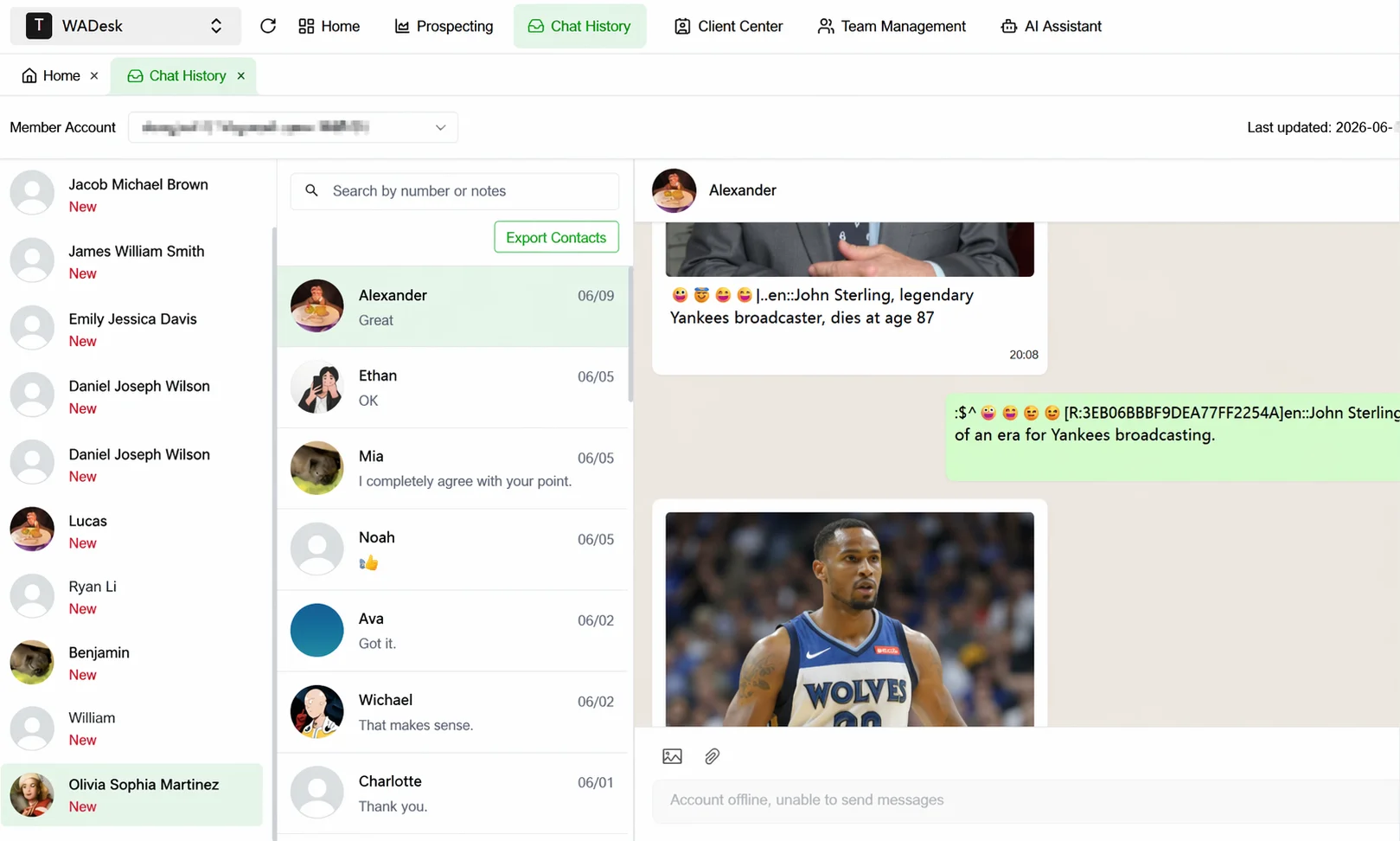
Best for: Salespeople who need one desktop workspace for several WhatsApp accounts, customer records, and follow-up reminders.
Why it stands out: WADesk brings prospecting and contact verification, bulk messaging, multilingual communication, customer profiles, reminders, group management, and team reporting into one workflow. The Pro plan is currently listed at $300 per year and supports five WhatsApp accounts. The Max plan is listed at $550 per year and adds group marketing, a shared lead pool, duplicate follow-up detection, team controls, and more storage. The workflow fits naturally into how salespeople already prospect, communicate, and follow up on WhatsApp.
Where it falls short: WADesk is not built on the official WhatsApp Business Platform API. If procurement requires the official API, or if the business needs deep store-order synchronization, helpdesk ticketing, or complex cross-channel automation, start with WATI, respond.io, SleekFlow, or an ecommerce-specific platform instead.
What to check before buying: Confirm how many accounts you need, who owns them, how accounts are handed over when an employee leaves, and who can send campaigns, export customers, or edit records. Test deduplication, lead assignment, reminders, and manager reporting in a real sales workflow rather than focusing only on message sending.
Category 2: Official API campaigns and automation
These platforms are designed for approved message templates, click-to-WhatsApp ads, opt-in management, and automated replies. If procurement requires an API-based product built on the official WhatsApp Business Platform, begin with this category.
WATI: WhatsApp marketing and support in one platform
Best suited for: Teams that want campaigns, a shared inbox, chatbots, and basic commerce features without assembling several products.
Key strengths: WATI includes campaigns, audience segmentation, a team inbox, automation, chatbots, catalogs, and integrations. At the time of review, the Growth plan was publicly listed at about $29 per month when billed annually. It is more complete than a basic broadcast tool when the same team handles both marketing and customer questions.
Potential drawbacks: Teams sending only occasional WhatsApp campaigns may not use enough of the automation and collaboration features. Kommo is more direct when a structured CRM pipeline is mandatory, while respond.io and SleekFlow are better suited to teams managing customer conversations across multiple channels.
What to test during the trial: Ask the vendor for a written quote based on your region, actual user count, automation volume, AI usage, and expected message volume. The quote should list Meta message fees separately; the public starting price is not a reliable estimate of total cost.
AiSensy: fast setup for campaigns and CTWA acquisition
Bottom line: AiSensy is easier to adopt than an omnichannel platform when the goal is to launch WhatsApp broadcasts, click-to-WhatsApp ads, and basic automation quickly.
Why choose it: AiSensy is built around bulk campaigns, segmentation, CTWA ads, chatbots, a shared inbox, and campaign reporting. Public international pricing starts at $45 per month for Basic, making it an accessible option for marketing teams that want to launch standard WhatsApp campaigns without a complex implementation process.
When it is not a fit: AiSensy may be too limited when several channels, complex sales stages, or many system integrations must work together. Advanced scheduling and audience segmentation may also require a higher plan.
What to confirm before buying or starting a trial: Run one real campaign through contact import, template submission, audience exclusions, scheduling, and results export. Confirm which steps require a plan upgrade and how Meta message fees are calculated.
Gallabox: chatbots, lead qualification, and automated follow-up
Best suited for: Small and midsize sales teams that want no-code chatbots to qualify leads, assign conversations, and automate follow-up.
Key strengths: Gallabox combines a shared inbox, chatbot builder, lead management, automated follow-up, and AI-assisted replies. The Basic plan is publicly listed at ₹2,999 per month when billed quarterly, making it an affordable starting point for small teams.
Potential drawbacks: Teams that only need broadcasting may find the chatbot and lead-flow setup unnecessary. Businesses that need complex cross-channel management or large contact-center operations should compare respond.io or SleekFlow. Companies outside India should also evaluate support hours and regional service coverage.
What to test during the trial: Automated follow-up is limited on Basic and may require Essential. Ask what “500 AI credits” means in actual usage, what overages cost, how many seats are included, and which data can be exported.
Category 3: Omnichannel customer communication
respond.io: complex customer assignment, automation, and integrations
Best for: Teams that must manage WhatsApp, social media, and other messaging channels together and route customers across departments. If the only requirement is WhatsApp broadcasting, respond.io is probably too complex.
Why it stands out: respond.io provides contact management, routing, automation, collaboration, AI, reporting, and integrations. The Growth plan starts at $159 per month and publicly includes ten users and 1,000 monthly active contacts. That cost can make sense when the platform replaces several inboxes and manual assignment steps.
Where it falls short: A small team with one WhatsApp channel, simple assignment rules, and no integration requirements is unlikely to justify the setup effort or starting price.
What to check before buying: Test one real cross-department workflow: how a message enters, who receives it, and what happens when nobody responds. Confirm monthly-active-contact overage pricing and whether WhatsApp fees and implementation services are included.
SleekFlow: AI-assisted omnichannel sales and support
Best suited for: Retail, ecommerce, and service businesses that want to manage customer conversations across product inquiries, sales, payments, support, and retention.
Key strengths: SleekFlow combines an omnichannel inbox, AI, campaigns, customer management, and commerce features. The Pro plan starts at $149 per month and publicly included three users and 500 monthly active contacts at the time of review. It covers more of the customer journey than a campaign-only platform.
Potential drawbacks: If the business uses only WhatsApp, or has many low-value contacts, SleekFlow's broad feature set and usage-based costs may be difficult to justify.
What to test during the trial: Confirm pricing for users, monthly active contacts, WhatsApp hosting, messages, and AI. During the trial, have your support team, sales team, and a manager test the full customer journey—from the first inquiry through purchase and after-sales support—then check whether data carries across every step.
Category 4: Customer records, follow-up tasks, and CRM stages
WADesk and Kommo both help sales teams manage customers, but they work differently. WADesk places customer records, conversation history, and follow-up tasks directly inside a multi-account sales process. Kommo expects teams to move leads through defined CRM stages. WADesk fits naturally into how salespeople already work on WhatsApp, while Kommo is better for companies with an established CRM process.
WADesk: customer records and follow-up for multi-account sales
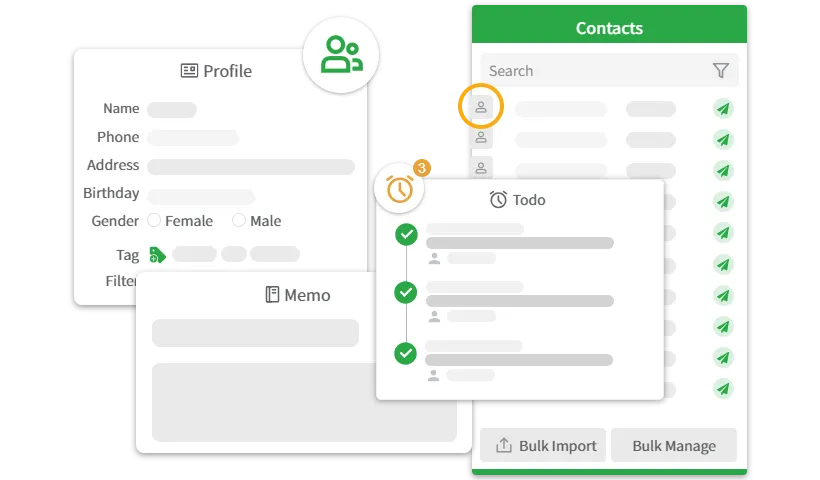
Bottom line: WADesk is easier to adopt than a full pipeline CRM when salespeople mainly work across several WhatsApp accounts and need customer profiles, notes, and reminders within that daily workflow.
Why choose it: Salespeople can review customer details, add notes, and set follow-up reminders while handling WhatsApp conversations instead of repeatedly switching to a separate CRM. Managers can also identify customers who have gone too long without follow-up. Account limits, pricing, and the difference from official API products are covered in Category 1.
When it is not a fit: WADesk is less complete than Kommo when the company requires strict opportunity stages, win probabilities, sales forecasting, and cross-department approvals. It should also not be the first choice when procurement requires the official WhatsApp Business Platform API.
What to confirm before buying or starting a trial: Test tags, notes, duplicate-contact handling, reminders, owner handoff, and data export with real customer records. Watch whether salespeople consistently update customer status and whether managers can quickly find overdue follow-ups.
Kommo: WhatsApp conversations inside a structured sales pipeline
Best for: Teams that connect every WhatsApp conversation to a lead owner, task, and pipeline stage. If the team does not maintain CRM stages, Kommo's main advantage disappears.
Why it stands out: Kommo is a CRM first, with a unified inbox, pipelines, tasks, customer records, automation, and Salesbot. The Advanced plan costs $25 per user per month and is the lowest tier that includes broadcasting. It works well for teams that need pipeline visibility and sales forecasting.
Where it falls short: Businesses focused on light broadcasting, Shopify support, or large contact-center operations do not need to pay for a full CRM structure. Kommo also becomes far less useful if users do not consistently keep lead ownership, tasks, and pipeline stages up to date.
What to check before buying: Calculate annual cost using the real number of users, then add messaging and integration costs. Import a representative lead set and test duplicate handling, stage changes, overdue reminders, automated tasks, and manager reports against the current sales process.
Category 5: Ecommerce support, order communication, and retention
It helps to distinguish between three different ecommerce use cases. WADesk supports sales-led cross-border ecommerce across multiple accounts. Interakt is designed around India-focused DTC. DelightChat centers on Shopify support, order messages, and retention. If store-order synchronization is the main requirement, do not treat WADesk as an ecommerce helpdesk simply because it supports customer follow-up.
Where WADesk fits in ecommerce
WADesk is worth considering when ecommerce sales teams use multiple WhatsApp accounts for prospecting, customer follow-up, and repeat sales. Test one complete journey from new lead to inquiry, quotation, follow-up, and repeat purchase. If store orders, product catalogs, or logistics integrations are mandatory, WADesk may not be the right fit. For Shopify tickets, order notifications, or abandoned-cart recovery, start with DelightChat or Interakt.
Interakt: DTC commerce for India-focused businesses
Best suited for: DTC brands focused on India that want WhatsApp campaigns, support, catalogs, and order management in one platform.
Key strengths: Interakt is designed around DTC commerce and combines campaigns, a shared support inbox, segmentation, catalogs, order management, and automation. Public US pricing starts at $55 per month for Growth. Unlimited users on some plans can be attractive to growing teams.
Potential drawbacks: Businesses outside India may not benefit fully from its local payments, commerce ecosystem, and service coverage. Teams with complex cross-channel processes or extensive enterprise integrations should also compare respond.io and SleekFlow.
What to test during the trial: Confirm that payments, catalogs, orders, and customer-service features work in the target country. Include template-message fees, automation limits, and store-connection costs in the quote.
DelightChat: Shopify support, order messages, and retention
Best for: Shopify support, order notifications, abandoned-cart recovery, and repeat-purchase campaigns.
Why it stands out: DelightChat combines a helpdesk, social and messaging support, WhatsApp marketing, customer records, and Shopify order information. The Startup plan starts at $29 per month and publicly included five team members, 2,500 marketing contacts, and 500 tickets at the time of review. For more detail, see our guide to WhatsApp CRM for ecommerce.
Where it falls short: DelightChat is less relevant for B2B prospecting, complex sales pipelines, and businesses outside ecommerce. SleekFlow covers more ground when advanced automation and cross-channel sales management are required.
What to check before buying: Connect a Shopify test store and verify order context, support assignment, abandoned-cart reminders, and retention campaigns. Confirm how pricing changes once you exceed 500 tickets or 2,500 marketing contacts, along with Meta fees and AI add-ons.
Entry price is not total cost
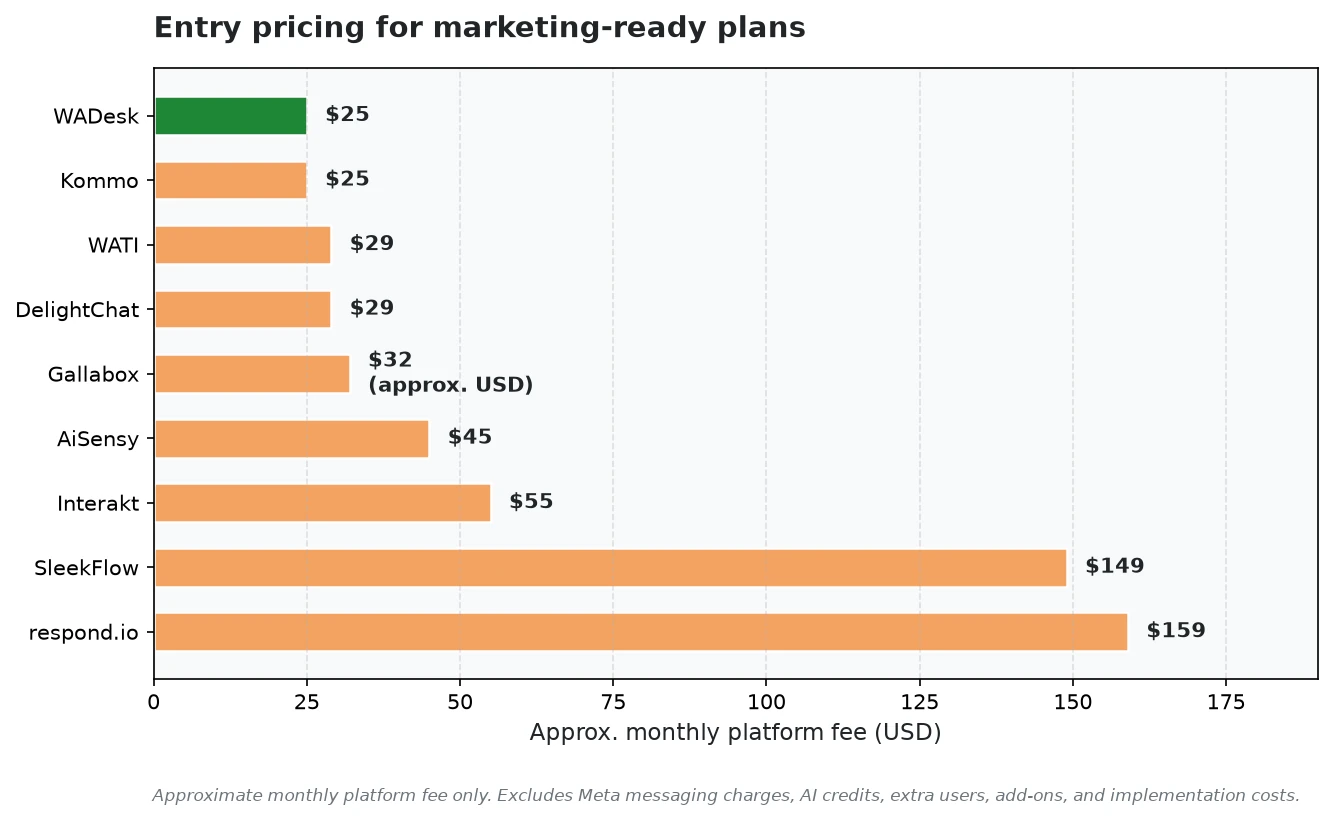
The chart converts some annual plans into approximate monthly prices, but it is not a total-cost ranking. Each product uses different pricing units:
- WADesk uses annual plans and account-slot limits.
- Kommo charges per user.
- respond.io and SleekFlow are affected by contacts, users, channels, or usage.
- Official API products may add Meta template-message fees.
- AI, automation runs, onboarding, training, and third-party integrations may cost extra.
- Gallabox charges in Indian rupees, so converted prices change with exchange rates.
Before buying, calculate a 12-month cost using your actual users, accounts, monthly active contacts, campaign volume, support conversations, AI usage, and required integrations. A plan that starts at $29 can ultimately cost more than one that starts at $149 once add-ons are included.
Give every shortlisted product the same test
Do not let each vendor demonstrate only the features it does best. Shortlist two or three products, then test them using the same set of opted-in contacts and the same tasks.
Days 1–3: Complete the basic setup
- Connect the accounts, phone numbers, and messaging channels you actually need.
- Import a small opted-in contact set and review duplicates and failed records.
- Create one audience based on a real use case and one assignment rule.
- Set up roles for a sales or support agent, a manager, and an administrator.
Days 4–7: Run a campaign and customer follow-up
- Send one policy-compliant marketing message to the test audience.
- Assign replies to named employees and create the next follow-up task.
- Review customer records, conversation history, and any available order details.
- Test unattended conversations, handoff, reassignment, and escalation.
Days 8–11: Check data, permissions, and integrations
- Ask users to attempt restricted actions and confirm that permissions work.
- Simulate an employee leaving and verify that customers and conversations can be reassigned cleanly.
- Export contacts, campaign results, and team data, then check the available fields.
- Test one critical integration, such as your CRM, ecommerce store, ad platform, or a webhook.
Days 12–14: Validate cost and make the decision
- Record setup time, manual corrections, import success, and export completeness.
- Record every usage limit, plan upgrade, and add-on encountered during the trial.
- Ask each vendor for a written 12-month quote based on current usage and expected growth.
- Buy only when the core workflow works, employees are willing to use it, and projected annual cost fits the budget.
This article does not present estimates as measured product performance. Use the tasks above to record how each shortlisted tool performs in your environment instead of relying on vendor demos and feature lists.
How to read the charts: shortlist tools, not a universal winner
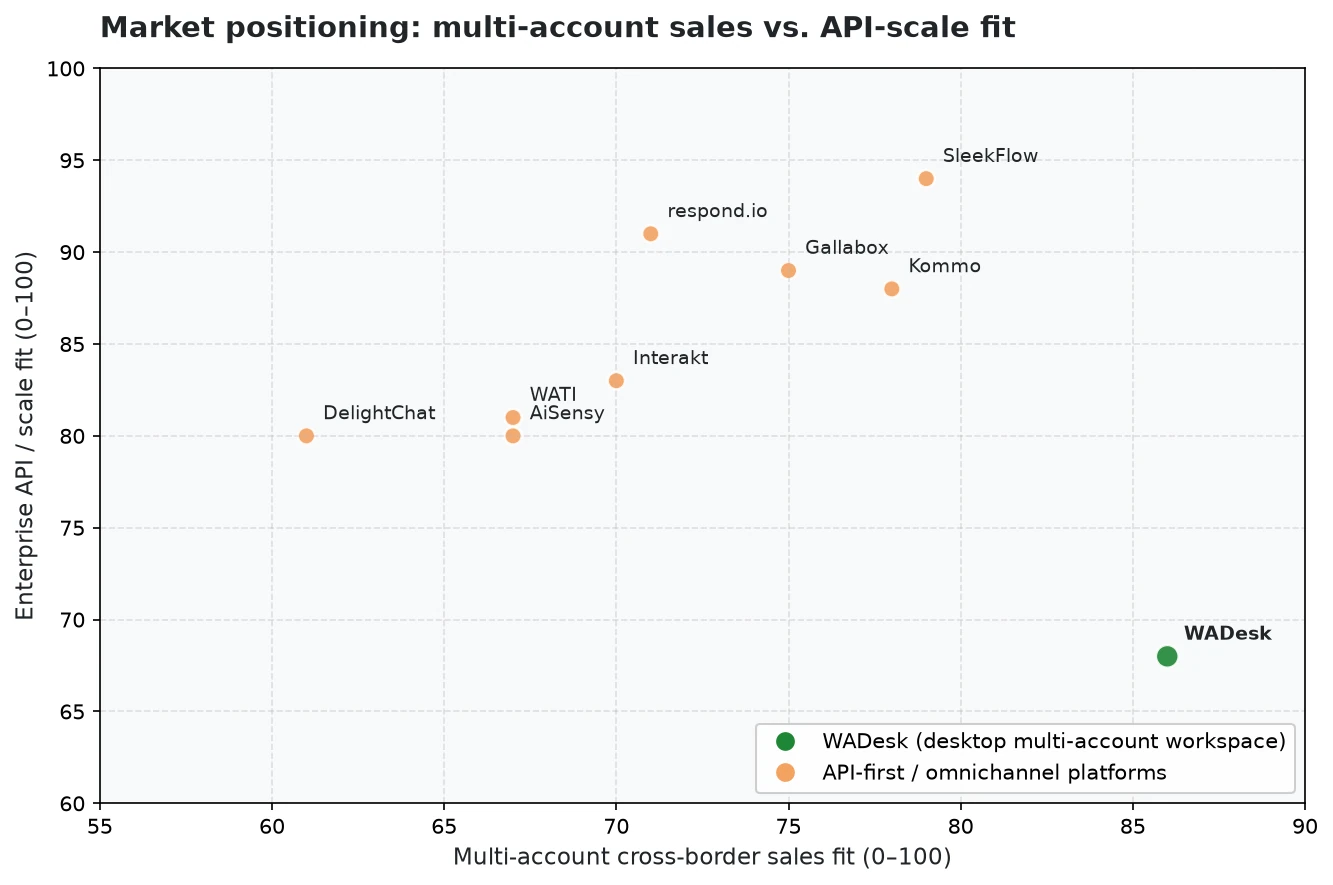
The map answers two practical questions: can the product manage high-volume messaging and connect to other systems through the official API, and can it support salespeople working across multiple WhatsApp accounts? Neither direction is inherently better. The answer depends on procurement requirements and daily operating habits.
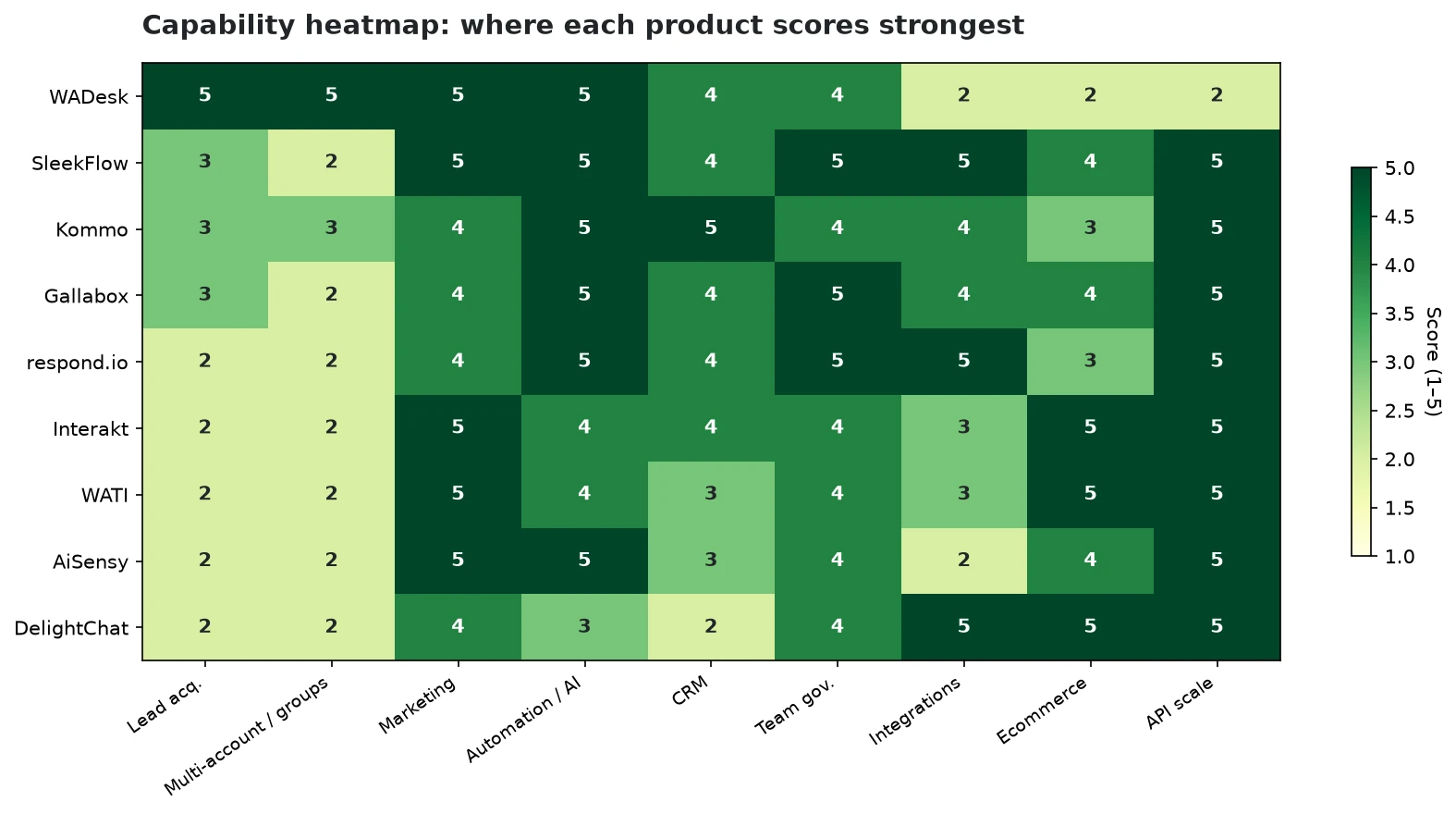
The heatmap uses editorial scores based on public product information and use-case fit. A score of 1 means the capability is unclear or a weak fit, 3 means the product can handle the basic task, and 5 means the task is a major product focus. The scores do not measure delivery rates, system performance, or business revenue, and they do not replace a trial.
Three practical conclusions stand out:
- If the main job is prospecting and follow-up across several accounts, test WADesk instead of choosing only by API capability.
- If several messaging channels and complex assignment rules must work together, respond.io and SleekFlow cover more ground but start at a higher price.
- If salespeople maintain owners, tasks, and stages every day, Kommo's CRM structure adds value. If Shopify orders and support are the priority, DelightChat is more direct.
Why these nine products are included
The nine products cover five common buying categories: multi-account cross-border sales, official API marketing, omnichannel communication, CRM pipelines, and ecommerce support. The goal is not to force different product architectures into one overall ranking. It is to help readers eliminate tools that do not match the way their business operates.
PushEngage, QuickReply.ai, Twilio, Brevo, and Zoko may still appear on other shortlists. They lean toward push notifications, ecommerce lifecycle automation, communications infrastructure, broader marketing automation, or Shopify commerce. Their product scope and pricing models are not directly comparable with the nine products in the main scorecard, so they are not included in the same scoring table.
If customer records, pipeline stages, and follow-up matter more than campaigns, continue with our WhatsApp CRM comparison.
Frequently asked questions
What is the best WhatsApp marketing software in 2026?
There is no universal winner. Start with WADesk for multi-account cross-border sales; compare WATI, AiSensy, and Gallabox for official API marketing; compare respond.io and SleekFlow for omnichannel communication; use Kommo for structured CRM pipelines; and consider Interakt or DelightChat for India-focused DTC and Shopify commerce.
How much does WhatsApp marketing software cost?
Public starting prices in this comparison range from about $25 to $159 per month. WADesk bills annually, and Gallabox bills in Indian rupees. Total cost may also include Meta fees, users, contacts, AI, automation, onboarding, and integrations. Compare 12-month cost rather than headline price.
Can WhatsApp marketing software send bulk messages?
Most products support campaigns or bulk operations, but the rules depend on the product architecture. API platforms generally require approved templates and valid opt-in. Businesses should also control sending frequency and follow the WhatsApp Business Policy and applicable privacy laws.
When should a business prioritize the official WhatsApp Business Platform?
Prioritize an API-based product when procurement requires the official API, or when the business needs high-volume messaging under defined permissions, integrations with other systems, and centralized automation. WADesk's desktop multi-account model is a different operating approach and should not be the first choice under those procurement requirements.
Which tool should a small business try first?
Do not choose by company size alone. Try WATI or AiSensy for official API campaigns, WADesk for several sales accounts, DelightChat for Shopify support, or Gallabox for chatbot-led qualification and follow-up. Without an omnichannel requirement, there is little reason to start with a more complex and higher-priced platform such as respond.io or SleekFlow.
Should a B2B WhatsApp sales team choose WADesk or Kommo?
Test WADesk first when salespeople prospect and follow up through several WhatsApp accounts. Test Kommo first when the company already manages lead owners, tasks, and sales stages in a CRM and wants WhatsApp conversations inside that process.
Final verdict: eliminate the wrong category before comparing tools
When choosing WhatsApp marketing software, write down the single most important job first, then remove products whose architecture, operating model, or total cost does not match it:
- Choose WADesk to manage multiple WhatsApp accounts, customer records, and sales follow-up; choose Kommo to place WhatsApp conversations inside a structured CRM pipeline.
- Choose WATI, AiSensy, or Gallabox for official API campaigns, advertising, and automated follow-up.
- Choose respond.io or SleekFlow to manage several customer communication channels together.
- Choose Interakt for India-focused DTC commerce and DelightChat for Shopify support, order communication, and retention.
If WADesk matches the way your team sells, review current pricing and compare it with at least one similarly priced alternative using the same test tasks. Base the final decision on the real workflow, a written quote, and your internal procurement requirements.
Pricing and plan information was reviewed on August 18, 2026 and may change. Confirm current details directly with each vendor. WhatsApp is a trademark of WhatsApp LLC; the products compared here are independent software products unless their own documentation states otherwise.