

Want to see the WADesk workflow behind this comparison? Explore the WADesk WhatsApp CRM page.
Your customers may be scattered across your team's personal phones — and your team may be working in silos. Pick the wrong tool, and you lose on both fronts.
According to Meta, over 200 million businesses worldwide now use WhatsApp Business. Every day, 175 million people send messages to business accounts. Industry sources cite WhatsApp's message open rate at roughly 98% (compared to just 20–25% for email) — while this figure represents an optimistic estimate, "WhatsApp open rates far exceed email" is a widely accepted consensus 1. For teams in cross-border e-commerce, international trade, and global marketing, WhatsApp is no longer an optional channel — it is core business infrastructure.
But native WhatsApp Business supports only one device and one user. No team collaboration, no data backup, no access control. The moment your team grows past three people — the moment you start worrying about whether departing sales reps will take their contacts with them, or when you need visibility into what each rep is discussing with clients — you stop needing "a better app." You need a real WhatsApp CRM.
Based on our hands-on experience serving over 1,000 foreign trade and cross-border e-commerce teams, customer asset security and multi-account proactive lead generation efficiency are the two requirements most frequently cited during tool selection — and they directly shaped the five evaluation dimensions in this guide.
The market offers plenty of options, but very few will actually fit your needs. This guide provides a side-by-side comparison of the 5 most representative WhatsApp CRMs in 2026, evaluated across five dimensions: multi-account management, customer asset protection, AI automation, lead generation tool completeness, and pricing & ROI — helping B2B teams identify which tool deserves real investment.
Transparency statement: We present each product's genuine capabilities and boundaries as objectively as possible, clearly noting strengths and weaknesses so readers can make independent judgments based on their own scenarios. Rankings reflect "scenario fit," not absolute quality scores.
First Things First: Which Technical Route Are You Buying?
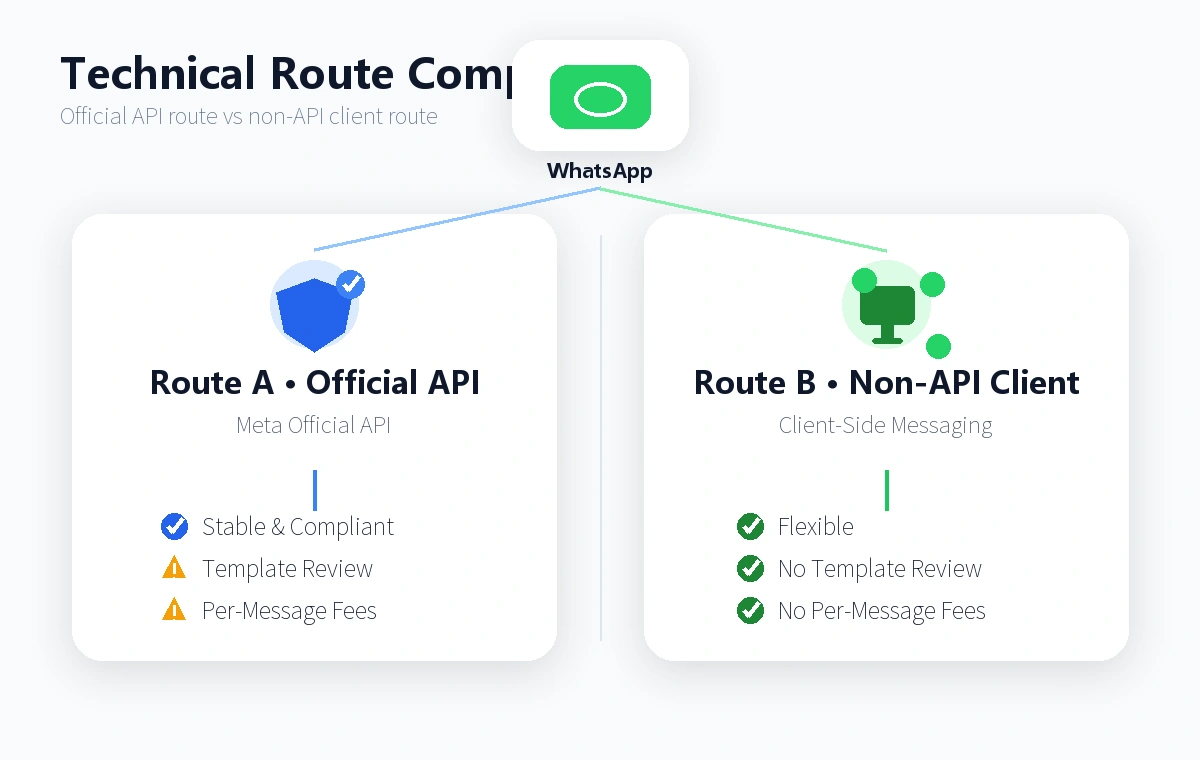
WhatsApp tools on the market fall into two primary categories based on underlying technology. This distinction shapes every downstream decision:
- Route A · Official API-based (used by Respond.io, WATI, and Kommo): Messages are sent and received via Meta's official API. Benefits include stability, compliance, official green-check verification, end-to-end encryption, and alignment with GDPR and other data-compliance frameworks. Trade-offs: messages must pass template review (typically several days), billing is per-conversation, and unsolicited bulk messaging is restricted.
- Route B · Non-API Client-side (WADesk's primary approach): Operates as a desktop client that simulates natural user behavior. Messages are free-flowing — no template review required, no per-message fees. Trade-offs: you must follow platform usage guidelines and maintain reasonable sending cadence.
The bottom line: If your core use case is "proactively reaching out to prospects and sending outreach campaigns at scale," the API route's template review process will slow your pace significantly. The non-API route offers more flexibility but requires disciplined adherence to platform norms. Neither is inherently superior — it depends entirely on whether it matches your business model.
Evaluation Dimensions & Scoring Methodology
This comparison revolves around five dimensions, each chosen deliberately:
Dimension 1: Multi-Account & Team Collaboration. For any sales team of five or more people, single-account tools should be eliminated from day one. We assess: can you manage multiple accounts from a unified interface? Is there a shared inbox with conversation assignment? Can managers see the full team's interactions?
Dimension 2: Customer Asset Security & Data Protection. The single most critical concern for B2B business owners. We assess: are chat records backed up to company-controlled cloud storage? When employees leave, does customer data survive and can it be reassigned? Are there anti-poaching mechanisms like number masking?
Dimension 3: AI Automation Capabilities. By 2026, AI is table stakes. We assess: is this rule-tree "pseudo-AI," or does it genuinely understand context and assist salespeople? Does it cover replies, translation, chatbots, and the full chain?
Dimension 4: Lead Generation & Marketing Tool Completeness. From prospect discovery to conversion — does the tool cover the complete lead generation funnel, or does it solve just one link in the chain?
Dimension 5: Pricing & ROI. Not just subscription fees, but hidden costs too (Meta API markup, per-user scaling traps) against measurable business returns.
Scoring note: The rankings and capability matrix below reflect fit for the typical scenario of "multi-account proactive outbound + customer asset security." If your priority is cross-channel support or pipeline visualization, Respond.io or Kommo may rank higher for your context — we flag this honestly in each section below.
Quick Overview: 5 Tools at a Glance
| Product | Tech Route | Starting Price (Monthly) | One-Line Positioning | Best For |
|---|---|---|---|---|
| WADesk | Non-API Client + Team Backend | Pro / Max flexible plans | Enterprise-grade all-in-one private-domain platform for multi-account trade teams | Teams needing both proactive outbound + customer asset security |
| Respond.io | Multi-channel API | $79+ (annual) 2 | Enterprise-grade omnichannel messaging platform | Enterprises operating across multiple channels with extremely high conversation volume |
| WATI | WhatsApp-focused API | $59+ (annual) 3 | Shared inbox purpose-built for WhatsApp support teams | Support-focused teams of 5–20 people |
| Kommo | CRM-core API | $15/user/month 4 | Kanban-pipeline legacy CRM | Small teams under 20, pipeline-centric |
| WADeck | Browser extension (Non-API) | Free tier available 5 | Free AI assistant embedded inside WhatsApp Web | Individual sellers, freelancers |
Prices captured July 2026; always verify at official websites.
#1: WADesk — The Enterprise Choice for Cross-Border Sales Teams
Website: wadesk.io | Positioning: An enterprise-grade private-domain marketing platform purpose-built for multi-account foreign-trade teams, simultaneously solving both efficiency and security.
Why Ranked #1?
Most WhatsApp CRMs solve one problem: making the team more efficient at handling messages. WADesk solves two: making the team more efficient AND keeping the enterprise secure. In B2B procurement decisions, this difference is decisive. Across the thousands of foreign-trade teams we have served, "sales reps taking clients when they leave" is the most frequently cited pain point — and also the most lethal. That is exactly why WADesk built client asset protection as a core capability, not an afterthought module.
WADesk uses a dual-end architecture — a desktop client for sales and operations staff, plus a team backend for managers — forming a closed loop of "execution + monitoring." Among non-API solutions, this is a rare design philosophy that places "flexible acquisition" and "asset control" within a single product.
Core Capabilities
Multi-Account Management: Tier-One Capability. A single client instance can manage 100+ WhatsApp accounts simultaneously. Each account can bind its own dedicated proxy IP (SOCKS5 / HTTP / VMess / Shadowsocks), with real-time online/offline/risk status visibility. A team of ten salespeople running 3–5 accounts each? Managers see every operational status on one screen.
Customer Asset Protection: Three-Layer Mechanism. This is WADesk's strongest differentiator — and the capability business owners should pay closest attention to. Layer one — Cloud Backup: Chat records sync to the cloud; even if an account becomes irregular or an employee departs, data remains intact in the backend. Layer two — Departure Control: Admins can disable an account with one click; customer data persists and can be directly reassigned to new sales reps. Layer three — Number Masking: When enabled, sales reps only see encrypted numbers (e.g., +86 138****8888), reducing at the source the risk of "manually copying down numbers to take away." These three layers are among the most complete in their category and align with GDPR compliance frameworks requiring enterprise-controlled customer assets.
Full-Chain AI Automation. AI Copilot analyzes buyer intent (high/medium/low) in real-time within the chat interface and suggests reply options; AI Auto-Reply uses a three-tier logic (keyword exact match → LLM-generated response → default fallback), supporting delayed replies to simulate human rhythm; AI Chatbot supports custom knowledge bases and multi-model selection (GPT family, DeepSeek, Gemini, etc.); AI Real-Time Translation supports multi-engine auto-translation for seamless cross-language communication.
Lead Generation Tools: Complete Funnel. The most complete lead-generation coverage among all five tools evaluated: Lead Prospecting (Google Maps keyword search for potential buyers) → Number Verification (batch filtering for valid numbers) → Routing Links (intelligently assign leads to designated sales reps, supporting weighted round-robin, user binding, online-first routing — significantly improving lead-to-conversion rates) → Broadcast Messaging (multimedia, variable personalization, safety policy configuration) → Community Marketing (batch group entry, group broadcast, read-status monitoring, active-user export).
Team Management & Risk Control. The team backend provides manager tools: real-time chat monitoring, data dashboards (multi-dimensional member performance comparison), three-tier RBAC permissions (team / department / role), and risk-control management (sensitive-word detection + AI monitoring, with real-time alerts).
What to Watch Out For
WADesk covers many modules, so new users should budget some initial configuration time. The non-API route requires following platform usage guidelines and maintaining reasonable sending cadence. We recommend mastering three core functions first — multi-account login, quick-reply templates, and broadcast messaging — then gradually introducing additional modules once those are stable.
Worried about losing clients when sales reps leave? See how WADesk turns "personal contacts" into "company assets."
Get Started with WADesk →#2: Respond.io — The Heavyweight for Multichannel Enterprise Teams
Website: respond.io | Pricing: Starter $79/mo+ (annual billing)
One-line positioning: The most feature-rich multichannel messaging management platform — suited for enterprises with technical resources who need unified operation across channels.
Respond.io has the broadest channel coverage among the five tools evaluated, supporting WhatsApp, Facebook Messenger, Instagram, Telegram, LINE, Viber, and nearly every major channel. It delivers advanced automation workflows, built-in CRM, AI-assisted replies (paid add-on), and detailed SLA reporting. For enterprises that need unified customer-conversation management across channels, its capabilities are beyond question.
However, the pricing bar is relatively high: entry starts at $79/month (annual), Growth at $159/month, Advanced at $279/month — plus Meta conversation fees (Respond.io does not add markup, but costs remain significant at scale). Total cost of ownership is not friendly to small-to-mid-sized teams. Configuration complexity is also substantial, requiring dedicated technical resources to build and maintain automation workflows.
For proactive B2B outbound specifically, Respond.io has clear boundaries: no non-API multi-account free broadcasting, no dedicated client asset protection mechanisms (no number masking, no departure-disable-with-reassignment). It is fundamentally a message processing platform, not an enterprise management system designed around "customer asset security" as its core principle.
Best for: Enterprises with dedicated technical operations teams, needing unified multichannel operation, with extremely high conversation volume (10,000+/month). Not ideal for: Teams whose core focus is proactive B2B outbound, needing multi-account free broadcasting and customer asset protection.
#3: WATI — The Focused Choice for WhatsApp Support Teams
Website: wati.io | Pricing: Growth $59/mo+ (annual billing)
One-line positioning: A shared inbox purpose-built and polished for WhatsApp support scenarios — focused features, solid stability.
WATI is one of the best-known tools in the WhatsApp Business API ecosystem, particularly popular in Southeast Asia and Indian markets. It supports managing multiple WhatsApp numbers from a single dashboard (official limit ~50), a unified shared inbox, a no-code chatbot builder, and broadcast tools — sufficient for basic support-team needs, with RBAC permissions included.
WATI faces two practical constraints: cost structure and feature boundaries. On cost, WATI adds approximately a 20% markup on top of Meta's base conversation fees — at 10,000 conversations per month (example estimate), Meta's base fee runs ~$300, WATI's markup adds ~$60, accumulating to roughly $700/year in extra costs for a single account. On feature boundaries, WATI is a single-channel product (WhatsApp-only), its chatbot uses rule-tree logic (not full contextual understanding), and it has no non-API free broadcasting, no client asset protection mechanisms (no masking, no departure-disable-with-reassignment) — creating a low ceiling for foreign-trade teams needing scaled proactive operations.
Best for: Single-channel WhatsApp support teams of 5–20 people with moderate volume (under 5,000 conversations/month). Not ideal for: Foreign-trade teams needing non-API multi-account free broadcasting, cost-sensitive high-volume users, or businesses requiring client asset protection.
#4: Kommo — The Legacy CRM Veteran with Pipeline Visualization
Website: kommo.com | Pricing: Base $15/user/month+
One-line positioning: A CRM-centric messaging platform where the kanban-style sales pipeline is the standout feature; WhatsApp is an added capability, not the core.
Kommo (formerly amoCRM)'s core strength lies in its kanban-style sales pipeline — an intuitive drag-and-drop interface that lets teams track every deal stage clearly. It subsequently integrated WhatsApp, Instagram, Facebook Messenger, and other channels into a "CRM + messaging" shape, with batch messaging capability through those channels.
For small teams whose primary focus is pipeline management and where WhatsApp is merely one of many channels, the experience flows smoothly. But there is a scaling trap in pricing: per-user billing ($15–$45/user/month) means costs double when growing from 10 to 20 people. More critically, Kommo's WhatsApp capability was "integrated in" rather than "natively designed" — it has almost no specialized capabilities for WhatsApp multi-account management or large-scale proactive outbound, the two pillars of foreign-trade workflows.
Best for: Small sales teams under 20, centered on pipeline visualization, with low-to-moderate WhatsApp usage. Not ideal for: Teams using WhatsApp as their primary acquisition channel who need multi-account free broadcasting.
#5: WADeck — The Free Starting Point for Individual Sellers
Website: wadeck.io | Pricing: Basic features free
One-line positioning: A free AI assistant embedded inside WhatsApp Web — suitable for individual sellers, not suitable for enterprises with team-management needs.
WADeck's greatest advantage is zero cost. As a browser extension embedded within WhatsApp Web, it provides ChatGPT-driven AI reply suggestions, auto-translation, message templates, and basic broadcast functionality. For individual sellers or freelancers, it is a low-barrier entry point.
But its free positioning also dictates clear functional boundaries: single account only, no multi-account management; no team collaboration (no shared inbox, no conversation assignment); no admin dashboard — managers cannot see what sales reps are discussing; no data backup — if an account is lost or compromised, data vanishes; no client asset protection — when employees leave, their contacts go with them.
In short, WADeck solves personal productivity, not enterprise management. Once your team exceeds two people and you begin worrying about client asset security, it ceases to be the right tool.
Best for: Individual sellers, freelancers, and micro-businesses just starting out with zero budget needing basic AI assistance. Not ideal for: Any business with team management needs or concerns about client asset security.
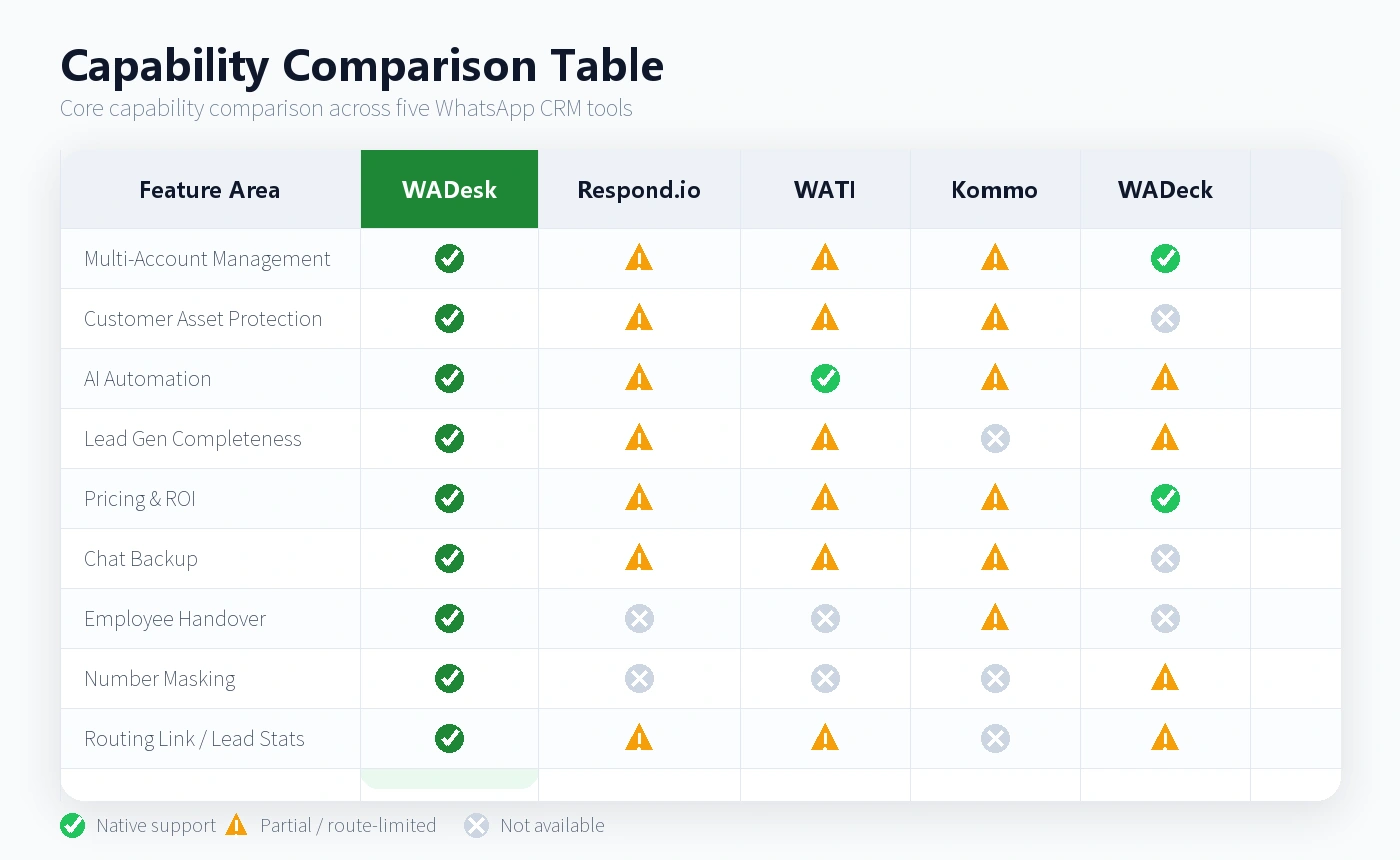
Capability Comparison Matrix
| Feature Dimension | WADesk | Respond.io | WATI | Kommo | WADeck |
|---|---|---|---|---|---|
| Multi-Account Management (Non-API, 100+) | ✅ | ⚠️ (API multi-number) | ⚠️ (API multi-number) | ⚠️ (limited) | ❌ |
| Shared Team Inbox | ✅ | ✅ | ✅ | ✅ | ❌ |
| Company-Controlled Cloud Backup | ✅ | ⚠️ | ⚠️ | ⚠️ | ❌ |
| Number Masking (Anti-Poaching) | ✅ | ❌ | ❌ | ❌ | ❌ |
| Employee Departure: Data Retention & Reassignment | ✅ | ⚠️ (data retained, no masking handoff) | ⚠️ (data retained, no masking handoff) | ⚠️ | ❌ |
| AI Smart Reply (Contextual Understanding) | ✅ | ✅ (paid add-on) | ✅ (AI classifier/bot) | ⚠️ | ✅ (basic) |
| AI Chatbot (Knowledge Base + Multi-Model) | ✅ | ✅ | ✅ | ⚠️ | ❌ |
| AI Real-Time Translation | ✅ (multi-engine) | ❌ | ⚠️ | ⚠️ | ✅ |
| Lead Prospecting (Google Maps) | ✅ | ❌ | ❌ | ❌ | ❌ |
| Number Verification | ✅ | ❌ | ❌ | ❌ | ❌ |
| Smart Routing / Distribution Links | ✅ | ✅ (routing) | ✅ (routing) | ⚠️ | ❌ |
| Broadcast Messaging (with Safety Policy) | ✅ | ✅ (API broadcast) | ✅ (API broadcast) | ✅ (channel broadcast) | ✅ (basic) |
| Community Marketing (Group Entry + Read Monitoring) | ✅ | ❌ | ❌ | ❌ | ❌ |
| Full Lifecycle CRM | ✅ | ✅ | ❌ (support-oriented) | ✅ (CRM core) | ❌ |
| Team Performance Dashboard | ✅ | ✅ | ✅ | ✅ | ❌ |
| Risk Control (Sensitive Words + AI Monitoring) | ✅ | ⚠️ | ⚠️ | ⚠️ | ❌ |
| Three-Tier RBAC Permissions | ✅ | ✅ | ✅ | ✅ | ❌ |
| Multi-Channel Support | WhatsApp-focused | ✅ (omnichannel) | WhatsApp-focused | ✅ (multichannel) | WhatsApp-focused |
| Requires Meta API Verification / Template Review | ❌ (No — non-API free broadcasting) | ✅ | ✅ | ✅ | ❌ (No) |
✅ Native support | ⚠️ Partial support or route-limited | ❌ Not available. WADesk's "No Meta API Required" means free broadcasting without template-review delays or per-message fees. API-based tools offer greater stability and compliance but are constrained by template review and per-conversation billing.
Which One Should You Choose? Match Your Scenario
Foreign-trade B2B team, 5+ members, core needs = multi-account proactive acquisition + customer asset security + AI efficiency → WADesk is currently the only tool covering all three simultaneously along this route. There is no direct alternative on the same path.
Business spans multiple messaging channels (beyond WhatsApp), has dedicated technical ops, extremely high conversation volume → Respond.io's multichannel depth and advanced automation merit consideration — but prepare for higher setup and total-cost-of-ownership investment.
Team focused on WhatsApp support, 5–20 people, moderate conversation volume → WATI is a stable choice — but watch for hidden costs from Meta API markups.
Small sales team under 20, centered on pipeline visualization, WhatsApp is a secondary channel → Kommo's kanban experience is worth trying — but beware the per-user scaling trap.
Individual seller or micro-business just starting, zero budget, basic AI assistance needed → WADeck is a zero-cost starting point — but upgrade promptly once your team scales.
Frequently Asked Questions (FAQ)
Q1: How does a WhatsApp CRM differ from just using the WhatsApp Business App? The native App supports only one device and one user — no team collaboration, backup, or permission controls. A WhatsApp CRM adds multi-account management, a shared inbox, client asset protection, AI automation, and lead generation tools — built for team and enterprise contexts.
Q2: How do I choose between API-based and non-API approaches (like WADesk)? If your core scenario is "proactively finding prospects and sending outreach campaigns at scale," the API route's template review (typically several days) and per-conversation billing will slow your pace and raise costs. A non-API solution like WADesk offers more message freedom with no template wait. If you prioritize official green-check verification and maximum compliance — and your usage is primarily customer-service oriented — the API route is more conservative. Neither is universally better; the key question is whether your business model centers on proactive acquisition.
Q3: Which tool fits a team under 5 people? If your goals are proactive acquisition plus asset security, WADesk's starter plans already cover this. If it's purely personal use with zero budget, WADeck works as a starting point — but lacks team and asset-protection capabilities.
Q4: How do I prevent sales reps from taking clients when they leave? Three things matter most: company-controlled cloud backup of chat records, number masking so reps cannot see complete phone numbers, and one-click disable with client reassignment upon departure. WADesk's three-layer mechanism is designed precisely around these principles. API-based tools typically retain data but lack masking and disable-reassignment capabilities.
Q5: Do all these tools require Meta's Official API? Respond.io, WATI, and Kommo all run on Meta's API (requiring verification, template review, per-conversation billing). WADesk follows a non-API client-side route — no template review needed for free broadcasting, but you must follow platform guidelines with reasonable sending cadence. WADeck is also non-API but limited to single accounts with no team capabilities.
The Bottom Line
Choosing a WhatsApp CRM comes down to answering one fundamental question: What role do you want WhatsApp to play in your business?
If it is merely a communication tool, basic products suffice. But if it is your primary channel for acquiring customers, maintaining relationships, and driving sales revenue, you need more than "a better inbox" — you need an enterprise-grade system that protects customer assets, quantifies team performance, and remains stable as your business scales.
That is the design philosophy behind WADesk.
Get started with WADesk today and see if it's the right fit for your team. Sign up to unlock a 3-day full-feature trial.
Get Started with WADesk → Book a Demo →Demos are customized by product consultants to your team size — approximately 30 minutes.