

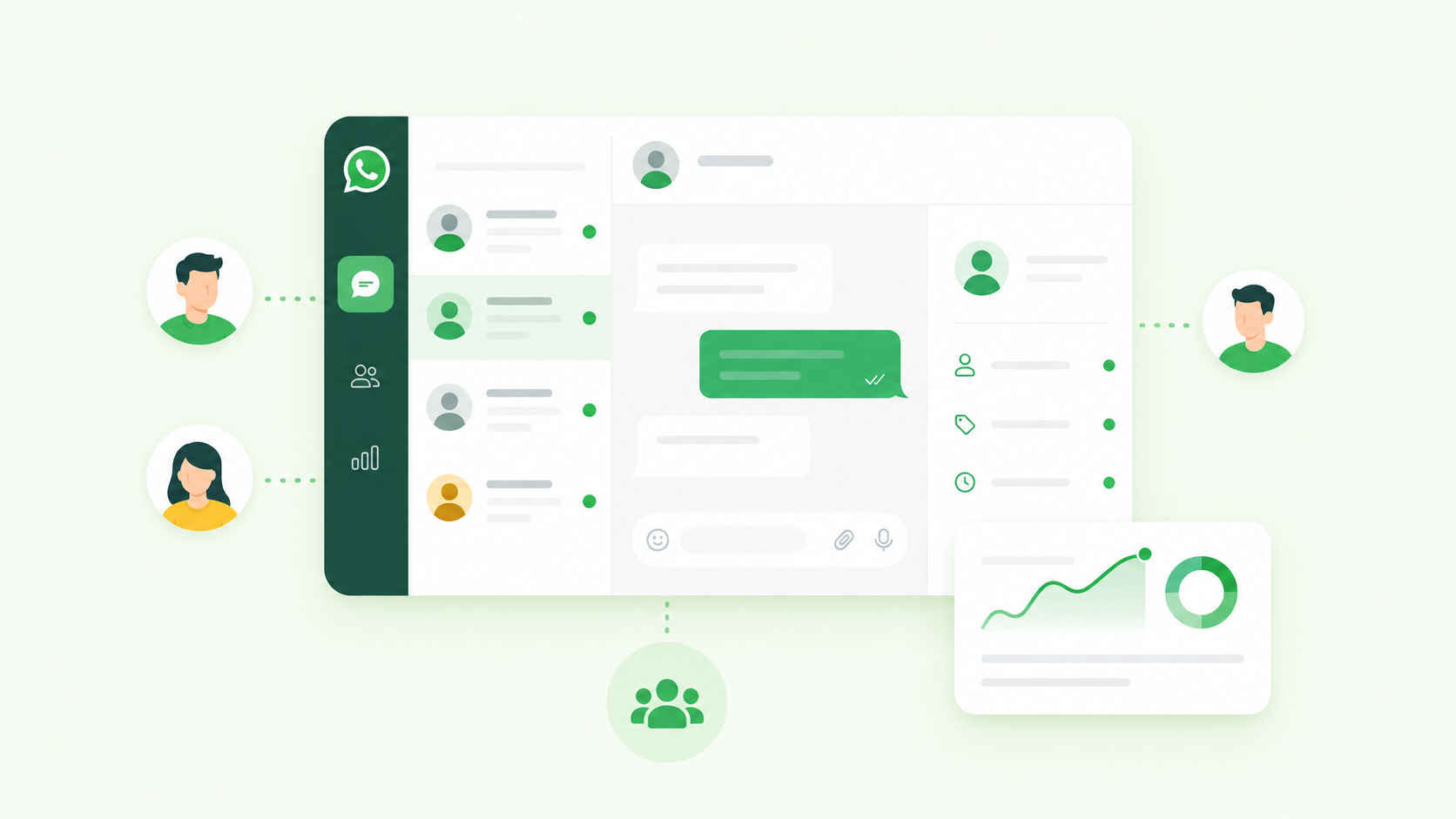
A WhatsApp shared inbox sounds simple: put customer conversations in one place so several people can work on them together. For a broader team workflow, see WADesk WhatsApp CRM.
For a support team, that description is often enough. A message arrives, someone answers it, the issue is resolved, and the conversation can leave the active queue.
Sales teams work differently. A distributor may ask for a catalogue today, request MOQ tomorrow, receive a quotation next week and then go quiet while discussing the deal internally. The conversation is not a ticket moving neatly from open to closed. It is part of a commercial relationship that changes over time.
That is why the value of a WhatsApp shared inbox goes beyond letting several people see the same chats. Centralizing conversations solves the visibility problem created by individual accounts, but it also creates a new operational question: once everyone can see the customer, who is responsible for moving the opportunity forward?
A useful sales inbox needs to answer that question without turning WhatsApp into a heavy CRM project.
Shared Visibility Changes How Ownership Works
Before a shared inbox, ownership is often messy but obvious.
A salesperson has their own WhatsApp account. Everyone knows that the Brazil distributors on that account belong to Lucas, while another number belongs to Maria's market. This setup creates information silos, but it also creates a natural responsibility boundary: if the customer is on your account, you are expected to handle them.
Once conversations move into a shared workspace, that boundary weakens.
Imagine a team returning from a trade show with more than a hundred new WhatsApp contacts. Several reps start working through them on Monday. Some buyers ask for catalogues, others request samples, one distributor wants freight to Dubai, and another asks for a revised quotation for 5,000 units.
Putting all of those conversations into one shared inbox is useful. Managers can see them, colleagues can cover when someone is away, and contacts are no longer trapped inside one person's device.
But visibility does not decide responsibility.
One rep assumes Maria is handling a buyer because she replied first. Maria assumes Lucas took over because he sent the catalogue. Lucas sees the conversation, but thinks the account belongs to another market. Nothing is hidden, yet the lead still drifts.
This is the part of shared inboxes that sales teams often underestimate. A private inbox may isolate information, but it gives every conversation an implied owner. Once the inbox becomes shared, that ownership has to be made explicit again.
For customer support, assigning the current conversation may be enough. Sales ownership usually lasts much longer. The person answering an MOQ question today may also need to arrange samples next week, revise pricing after that, and follow up again once the buyer has spoken to purchasing.
The useful question is therefore not simply, “Who should answer this message?”
It is, “Who is responsible for making sure this opportunity does not disappear?”
WADesk handles this through a lead workflow rather than treating every visible chat as automatically owned. Administrators can place leads into a company-level pool, assign them to specific salespeople, and transfer them when responsibilities change.
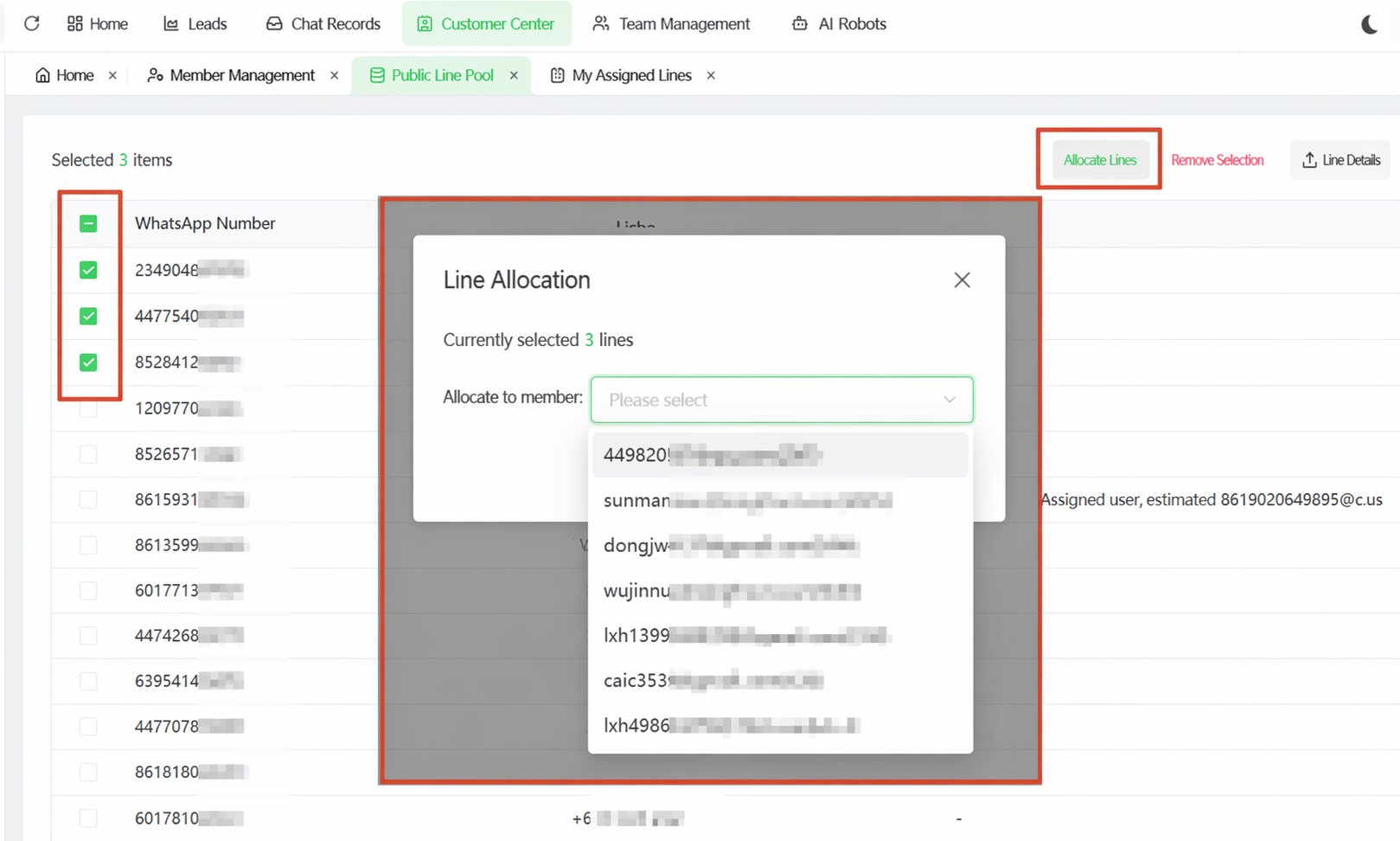
Shared visibility becomes much more useful when every active lead has a clear owner.
The important part is not the assignment feature itself. It is the operating rule behind it: once a lead matters commercially, somebody needs to own what happens next.
A Sales Inbox Needs to Preserve Commercial State
Many shared inboxes inherit concepts from customer support: open, pending, closed.
Those states make sense when a conversation represents a problem that can be completed. A customer asks where their order is, an agent checks the tracking information, the issue is resolved, and the conversation is done.
Sales conversations rarely fit that model.
Suppose a distributor asks for samples. The samples are shipped on Tuesday and will arrive the following Monday. There may be nothing useful for the salesperson to say for several days, but the opportunity is still active.
Or a buyer says:
“The price looks okay. Let me check with my boss.”
There is no unanswered message. The chat may remain quiet for four days. Operationally, however, the salesperson probably needs to follow up on Friday.
The same silence can mean very different things.
A buyer waiting for a sample is different from a buyer who rejected the price. Someone calculating landed cost is different from someone who downloaded a catalogue and never replied. A distributor waiting for internal approval is different from a lead that has genuinely gone cold.
This is where sales teams need to preserve commercial state outside the raw sequence of WhatsApp messages.
A simple workflow may be enough:
New Lead → Interested → Quotation Sent → Sample / Evaluation → Follow-Up → Won / Lost
The exact labels are less important than what they help the team remember. When a salesperson opens the workspace on Friday morning, they should not have to mentally reconstruct which of 70 quiet conversations deserves attention.
This matters especially in B2B sales because much of the buying process happens outside WhatsApp. Purchasing managers discuss budgets internally. Finance approves payment terms. Buyers compare suppliers. Logistics teams calculate freight.
A deal can therefore move forward while the WhatsApp chat remains completely silent.
That is the point where a shared inbox starts to need CRM-like context. Not because every sales team needs a complex CRM, but because the inbox itself cannot reliably tell you why a customer is quiet or what should happen next.
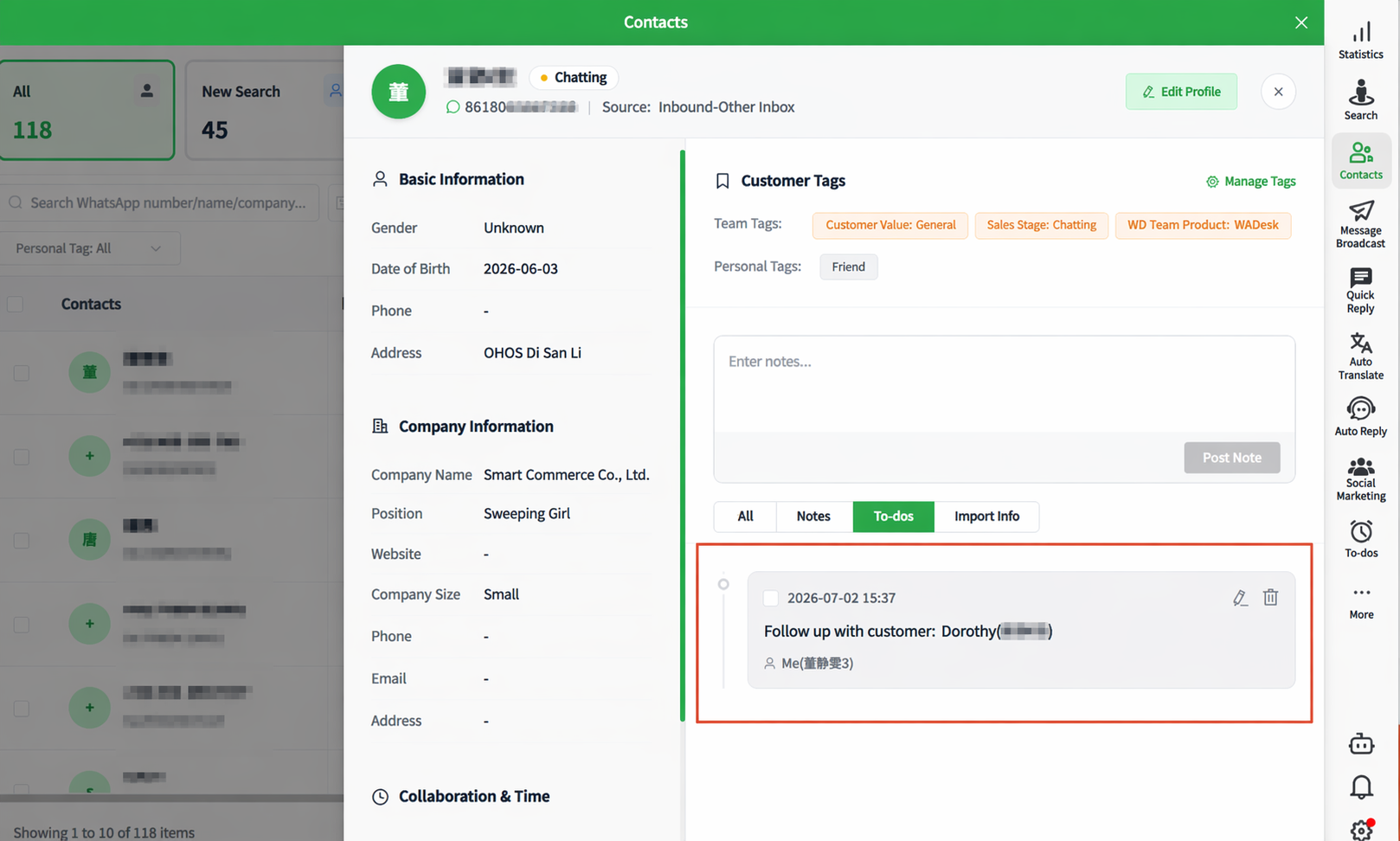
The important context often sits around the conversation: who owns the buyer, what has already happened, and what should happen next.
This is also why separate CRM administration often breaks down in practice. If a salesperson replies to a buyer in WhatsApp and then has to open another system to update the same opportunity manually, the customer-facing work gets done first. The CRM update gets postponed, and eventually the data stops matching reality.
The closer customer context sits to the place where the conversation already happens, the easier it is to keep that information current.
Managers Need Exceptions, Not More Chats
A shared inbox looks very different depending on whether you are a salesperson or a manager.
A salesperson needs customer-level detail. Who should I follow up today? Did I already send the quotation? Has the sample arrived? What did the buyer say about price?
A manager should not need to answer those questions for every customer.
With ten reps and twenty WhatsApp accounts, reading more conversations is not better visibility. It is simply more work.
This becomes obvious as companies add separate accounts by country, salesperson or product line. Each rep may understand their own two accounts perfectly well. They know which distributor is likely to order, who is negotiating hard on MOQ, and which buyer is probably not worth another follow-up.
The manager cannot maintain that same mental model across twenty accounts.
They could technically open every account, scroll through recent chats and ask each salesperson for context. Repeating that every morning is not a management system.
What managers need is exception-level visibility: enough information to identify where the workflow looks abnormal and where they should investigate.
If one account suddenly accumulates far more unanswered conversations than usual, that deserves attention. If a salesperson's response time deteriorates sharply, something may be wrong with workload or process. If one market generates a large number of inquiries but very little subsequent activity, the manager may need to look at lead quality or follow-up.
The purpose of a management view is to narrow attention, not expand it.
That means the salesperson and the manager should not be looking at identical versions of the same inbox. The salesperson needs detail; the manager needs patterns.
WADesk's team dashboard provides that higher-level layer by aggregating customer and communication activity across members and accounts instead of requiring managers to inspect each WhatsApp session individually.
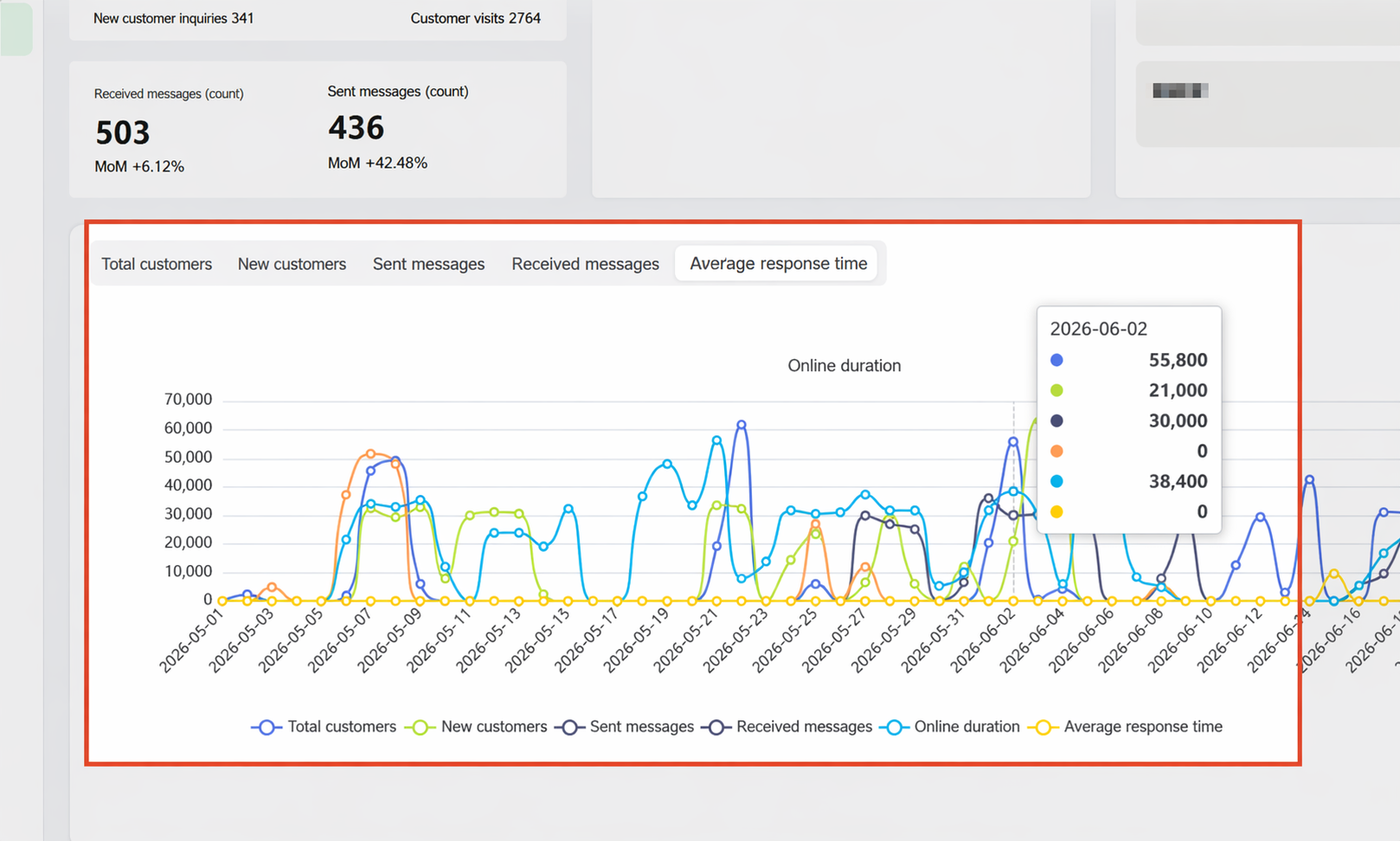
Sales reps need customer detail. Managers need to see where the team's workflow requires attention.
This is also why multi-account management becomes more valuable as the organization grows. Putting twenty accounts inside one application saves switching time. Giving managers a way to understand what is happening across those accounts is the bigger operational improvement.
Handover Shows Whether the Customer Belongs to the Rep or the Company
One of the clearest tests of a shared inbox is what happens when the original salesperson is unavailable.
That may be a permanent handover because someone leaves the company, or something much more ordinary: annual leave, sick leave, territory changes, or a temporary workload transfer.
Imagine a salesperson who has managed a distributor for nine months. The WhatsApp history contains the first catalogue request, several quotations, sample photos, freight discussions and voice messages about packaging.
The information exists. The replacement simply does not know which parts matter.
They may spend twenty minutes reading through the conversation just to understand a customer the previous rep could explain in thirty seconds. While that is happening, the buyer waits longer for an answer. If forty customers are transferred at once, the new salesperson also has to work out which five deserve immediate attention before they can even start following up properly.
That is the practical cost of customer context being tied too closely to one person's memory.
There is also a trust cost. A message such as:
“Hi, I'm taking over from David. Can you remind me what you discussed?”
tells the customer that the company itself does not have a very strong memory of the relationship.
For a simple one-off transaction, that may not matter. For a distributor who has spent two months discussing samples, pricing and a larger order, it can.
A good shared environment reduces this friction by making customer responsibility transferable and keeping enough context available that another salesperson can continue the relationship without starting again from zero.
This is why team size alone is a weak signal for whether a shared inbox is needed. A four-person export team with long sales cycles and frequent handovers may benefit much earlier than a larger team handling simple one-message inquiries.
What to Look for in a WhatsApp Shared Inbox for Sales
Once the problem is framed this way, the feature checklist becomes much shorter.
For a sales team, I would pay more attention to responsibility and continuity than to how many automation features appear on the pricing page.
The useful questions are:
- Can an active lead have a clear owner?
- Can that ownership be transferred when the team changes?
- Can salespeople understand the customer without rereading months of chat?
- Can the workflow distinguish a quiet active deal from a dead conversation?
- Can managers identify problems across several accounts without reading every message?
If those basics are missing, more AI replies or complicated routing rules will not fix the underlying workflow.
This is also where the line between a WhatsApp shared inbox and a WhatsApp CRM becomes less important. Shared inbox products are usually conversation-first, while CRM products add more structure around customers and opportunities. Sales teams often need some of both.
The label matters less than whether the system preserves the information that tends to disappear when WhatsApp moves from an individual salesperson's tool to a team sales channel.
A Shared Inbox Should Reduce Ambiguity
The first stage of growth often creates private inboxes: every salesperson understands their own customers, but the company sees too little.
A shared inbox fixes that visibility problem. The next challenge is making sure responsibility, customer context and follow-up remain clear once those conversations become shared.
That is when a shared inbox starts to become part of the sales operating system rather than simply a more convenient place to read messages.
WADesk is built for teams working at that stage, combining multiple WhatsApp account management, team access, lead assignment and manager-level visibility in one environment.
Frequently Asked Questions
What is a WhatsApp shared inbox?
A WhatsApp shared inbox is a workspace where multiple team members can access and handle WhatsApp customer conversations instead of leaving them isolated across individual devices or accounts.
Is a WhatsApp shared inbox the same as WhatsApp Business linked devices?
No. Linked devices primarily extend access to a WhatsApp account. Shared inbox products generally add team workflow such as centralized conversation handling, assignment, permissions or reporting, depending on the platform.
Why can shared visibility make ownership less clear?
Private accounts create an implicit responsibility boundary because the salesperson using the account usually owns the customer. Once conversations move into a shared workspace, that boundary becomes less obvious, so teams usually need explicit assignment or ownership.
What should a sales shared inbox track beyond messages?
For longer sales cycles, useful context includes customer ownership, lead or opportunity status, and the next expected action. A buyer may remain commercially active even when there has been no recent WhatsApp message.
Do managers need to read every WhatsApp conversation?
Usually not. Managers benefit more from team-level patterns and exceptions that show where response times, workloads or lead follow-up require investigation.
Can WADesk assign leads to different salespeople?
Yes. WADesk administrators can place leads into a company lead pool, assign them to specific members and transfer responsibility when needed.
Can WADesk manage multiple WhatsApp accounts?
Yes. WADesk is designed to manage multiple WhatsApp accounts inside a shared team workspace, alongside customer and team-management capabilities.