

An Owner's Perspective
Li Ming runs a consumer electronics export company — 15 people, ~$4M annual revenue. He's been calculating a different kind of cost. Not product margins. Customer assets.
"I spend hundreds of thousands every year on Google Ads and trade shows to acquire new customers," he says. "But I've never seriously calculated what I'm losing in existing customer attrition."
Then his sales director of 3 years moved to a competitor. That director had 400+ WhatsApp contacts, at least 150 of whom were long-term repeat buyers.
"I don't blame him," Li says. "Those were his personal WhatsApp accounts. Taking them when he left is only natural. But it made me face a harsh truth — the customers I paid to acquire weren't actually mine."
Those 150 clients conservatively delivered about $1M in annual revenue. How many would follow the departing sales director? Maybe 30%, maybe 50%. That's his real loss — not operating costs, but customer asset erosion.
Three Levels of Customer Asset Leakage
Li Ming's problem isn't unique. From a B2B export company's perspective, customer asset leakage happens at three levels:
Level 1: Sales Take Customers When They Leave
This is the most visible loss. Sales use personal WhatsApp numbers. When they leave, they take the contacts. Even if the company provides accounts, without centralized management, departing sales can easily export contacts and chat history.
Industry averages suggest 15-25% annual sales turnover in export teams. Each departure costs the company 30-50% of that rep's recurring orders — not because clients dislike the product, but because they're used to that rep's contact channel. Successors start from zero trust.
Level 2: Customer Data Scattered Everywhere
Each sales rep manages their own WhatsApp accounts and contacts. New hires don't know which clients have already been served, which are in negotiation, or what was quoted before. A client says "I've already received your quote" — but nobody knows what was quoted because the history is on someone else's phone.
This is especially common in export teams where the default WhatsApp workflow is "everyone installs their own number." Customer data is naturally fragmented — there's no centralized view.
Level 3: Management Is Blind to Customer Health
The owner wants to know: How's my team tracking? Which clients are active? Which are drifting away? But there's no data to support decisions. Customer loss signals only surface 3-6 months after a departure — "That client stopped ordering" — by which time the window for recovery has passed.
The long-term impact: the company invests heavily acquiring new customers every year, while its existing customer base silently shrinks.
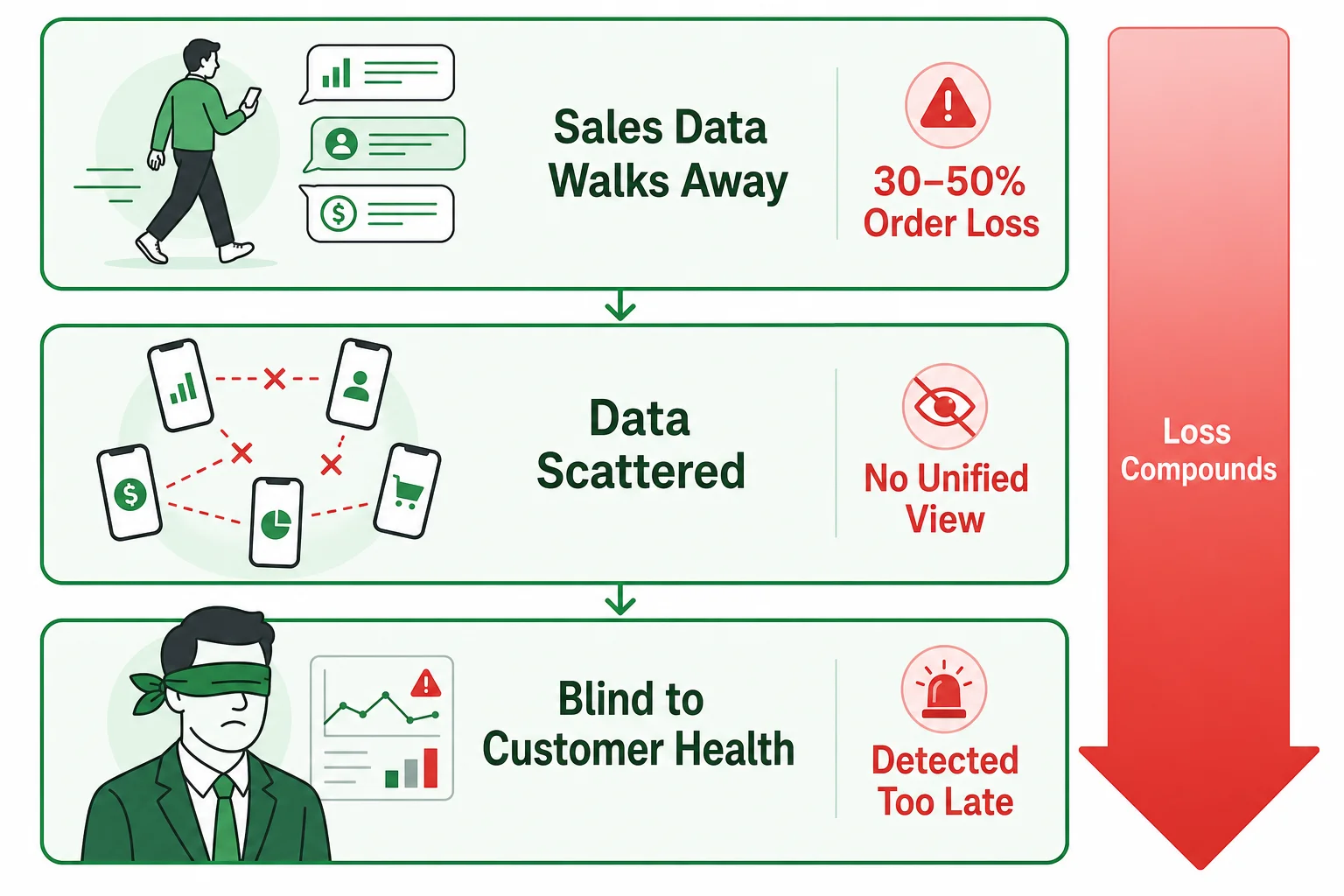
▲ Three leakage levels: Level 1 — sales departures cost 30-50% of their client orders; Level 2 — customer data scattered across personal phones (no unified view); Level 3 — management blind to customer health (detection too late). Each layer compounds the loss.
How WADesk Locks Customer Assets to the Company
WADesk addresses all three leakage levels:
① Company-Managed WhatsApp Accounts
The WADesk desktop client supports simultaneous multi-account login — the company configures and assigns accounts to sales. All accounts are company property, not personal. When a sales rep leaves, the admin releases the account and reassigns it. All contacts, chat history, and customer labels transfer intact.
The key shift: Customer contact points are no longer tied to a sales rep's personal phone. They're tied to a company account. Departing sales can't take the number — so they can't take the customers.
② Cloud Data Retention, Team-Wide Visibility
All WhatsApp chat history, customer info, and quote history sync to the cloud in real time. When a new rep takes over, they see the full conversation history — what was quoted, what the client requested, where issues stand. Information continuity is preserved across personnel changes.
For WADesk Web dashboard users, management can view the complete communication history by customer — not second-hand reports from a sales rep.
③ Real-Time Management Dashboard
The WADesk Web dashboard provides management-level views: team customer activity, follow-up progress, message response rates. No need to wait for monthly reports — the owner can check anytime:
- Which clients have active communication in the last 7 days
- Which clients have gone silent for 30+ days (potential churn risk)
- Workload and efficiency comparisons across the team
The real value: customer loss becomes a trackable management metric, not a post-mortem surprise.
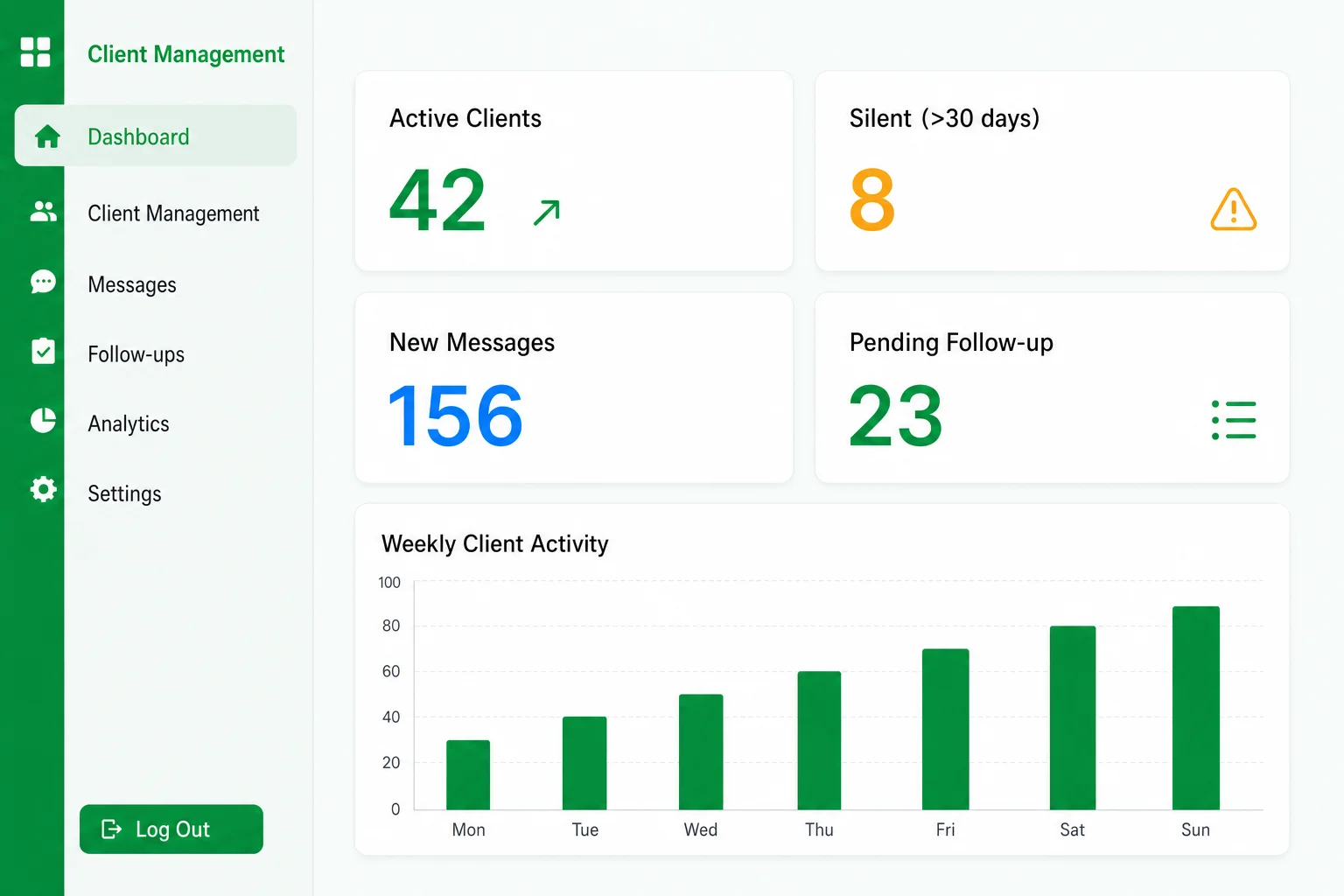
▲ From the owner's chair: WADesk's dashboard gives real-time visibility into customer health — who's engaging, who's gone quiet, how the team is performing. No more waiting for monthly reports.
ROI from a Cost Perspective
Illustrative estimate for a mid-sized export company (10-person team, ~$3M annual revenue):
| Cost/Benefit Item | Annual Amount | Note |
|---|---|---|
| Pre-WADesk Losses | ||
| Customer loss from sales turnover | ~$180-300K/year | 20% turnover rate, 30-50% lost orders per departure |
| Customer data rebuild cost | ~$45-75K/year | New hires rebuilding relationships from scratch |
| Investment | ||
| WADesk team licensing | ~$4-9K/year | 10-person team, per product pricing |
| Deployment & training (one-time) | ~$1.5-3K | Onboarding and adjustment period |
| Post-WADesk Benefits | ||
| Customer asset preservation | ~$120-220K/year | Reduced client loss from sales departures |
| New hire ramp-up efficiency | ~$22-45K/year | Complete data handoff, shorter trust-building |
Note: These are illustrative estimates based on typical industry scenarios. Actual figures vary significantly by team size, industry, and competitive landscape. The core takeaway: every $1 invested in customer asset protection typically avoids $10+ in hidden revenue loss.
Getting Started: Three Steps to Customer Asset Protection
Step 1: Centralize Accounts (Week 1)
Migrate your team's core WhatsApp accounts from personal phones to WADesk unified management. This step is critical: make the customer contact point a company number, not a personal number. Start with 2-3 core sales accounts as a pilot, then roll out.
Step 2: Complete the Data Picture (Weeks 1-2)
Import existing customers into WADesk and add tags, groups, and notes. Start with a basic three-category system: "won / in-progress / dormant." Refine as you go based on actual operations.
Step 3: Launch the Management Dashboard (Week 2+)
Activate the WADesk Web dashboard. Spend 10 minutes weekly reviewing team-level customer health — who's active, who's gone quiet, what's out of balance. Make customer churn a weekly management metric, not a quarterly surprise.
FAQ
Q1: What's the risk of sales using personal WhatsApp? Can we force them to use company accounts?
The biggest risk is customer assets leaving with the person. When a sales rep departs, all contact info and chat history are lost — leads the company paid to acquire become the rep's personal network. In practice, it's very difficult to force existing reps to switch after they've already established personal numbers. The best approach is to set up company accounts during onboarding as a standard workflow. WhatsApp customer asset protection and sales departure prevention become unavoidable issues once a team grows beyond a few people.
Q2: How do we migrate clients from a departing rep's personal WhatsApp?
WADesk supports multi-account management — sales can run personal and company accounts in the same client. The recommended migration approach: gradually guide clients to add the company number as their "official communication channel" — for example, tell clients they'll receive faster quotes and updates through the WADesk company number. This takes 2-4 weeks of natural conversations, not a one-time transfer. WhatsApp customer data handoff and departure protection is exactly what this mechanism addresses.
Q3: Can management see the content of sales chat conversations?
Yes. The WADesk Web dashboard allows viewing complete chat history by customer. We recommend establishing a clear privacy policy so sales know that chat data is company-visible. For small-to-mid-sized trade teams, transparent management is essential infrastructure for customer asset protection and team efficiency — not surveillance.
Q4: How is WADesk different from traditional CRM?
Traditional CRM requires sales to manually log customer data and activity — "how far along is this deal" depends on whether the sales rep remembered to update it. WADesk's core difference is automatic WhatsApp data capture — every conversation, quote history, and requirement change is synced automatically with zero manual entry. For B2B export customer relationship management, auto-captured data is more accurate, complete, and timely than manually entered records.
Compliance note: Customer churn rates and ROI figures are illustrative estimates based on typical industry scenarios. Actual numbers vary by team size, industry, and competitive landscape. WhatsApp is a registered trademark of Meta Platforms, Inc. All third-party trademarks are the property of their respective owners.